outils SaaS & Productivity — 274 tools curated by the community. Most popular: Kagelin, Compilr Studio, Groundbeat. Each tool comes with a review, tags and alternatives to help you choose.
❓ Frequently asked questions about SaaS & Productivity
What is SaaS & Productivity?
SaaS & Productivity groups 274 tools curated by the mySelectas community. Most popular: Kagelin.
What are the best free SaaS & Productivity tools?
mySelectas lists several free options in this category. See in particular: Kagelin, Compilr Studio, Groundbeat.
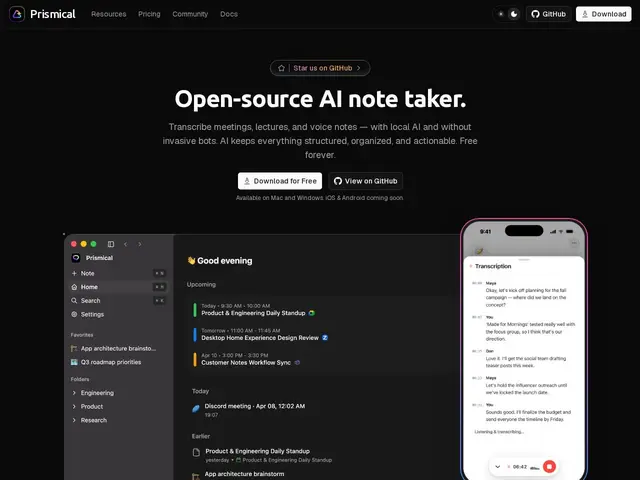
The short version: Kagelin's real differentiator isn't any single feature — task management, habit tracking, and calendars all exist elsewhere — it's the combination of offline-first architecture, AGPL open-source licensing, and an explicit refusal to use engagement-driven design patterns.
Mainstream tools like Todoist or TickTick are more polished and have larger ecosystems, but they're built around retention metrics and require an account and connectivity to function well; Kagelin's offline-by-default model and local data storage matter if you specifically want a tool that doesn't need you …
👥 Target audience
Développeurs et professionnels de la connaissance cherchant un outil sans distraction, offline-first, avec propriété totale des données.
The short version: Compilr Studio's bet is that AI agents should write directly into your project's living documentation instead of humans manually keeping a wiki in sync — and the MCP integration is what makes that plausible.
Compared to Notion or Confluence, which are general-purpose docs tools that AI agents can only edit indirectly, Compilr Studio is purpose-built around a structured graph (objectives, decisions, risks, work) with automated consistency checking baked in, rather than free-form pages. Against Linear, which tracks work items well but doesn't model the reasoning behind decisi…
👥 Target audience
Chefs de produit et de projet ayant besoin de traçabilité entre décisions, exigences et exécution du travail, notamment dans des équipes assistées par IA.
The short version: Groundbeat turns the passive experience of reading a poll result into an active one — you vote, then instantly see how your answer stacks up against other demographics — which is a neat trick for a site that's ultimately still just another open polling tool.
Groundbeat sits between professional pollsters (YouGov, Pew Research, Morning Consult) and lightweight social polling features (X/Twitter polls, Reddit polls, Instagram Stories polls). Its differentiator is the demographic-breakdown view combined with a continuously running, always-on poll feed rather than one-off surve…
👥 Target audience
Internautes (principalement US) intéressés par l'actualité, la politique et l'opinion publique en temps réel
🌍 Target countries
États-Unis (contenu et démographie orientés marché américain)
The short version: SignFile does one job — collect a legally binding signature on a PDF without friction for either side — and does it at a price that undercuts the big incumbents by a wide margin.
DocuSign and Adobe Sign dominate this space but are priced and built for enterprise procurement, with plans that often start well above SignFile's $19/month unlimited tier and feature sets (workflow automation, deep CRM integrations, compliance certifications) that a freelancer or five-person team will never touch. SignFile's bet is that most small businesses just need "send PDF, get it signed, ver…
👥 Target audience
Professionnels indépendants, freelances, consultants et petites équipes ayant besoin de faire signer des contrats, NDA, baux ou offres commerciales
The short version: a free, genuinely capable alternative to commercial head-tracking mouse software, with the added bonus of being embeddable directly into web apps.
Against eViacam, the most commonly cited alternative, Tracky Mouse's differentiators are being open source (auditable, no cost, community-improvable) and offering a JavaScript library that developers can embed in their own web apps for built-in accessibility — something a desktop-only competitor can't do. The trade-off of being a community project rather than a commercial product is the usual one: no dedicated support line, and q…
👥 Target audience
Personnes à mobilité réduite et développeurs souhaitant intégrer un contrôle mains-libres dans une application web.
🌍 Target countries
Marché anglophone international
🗣️ Available languages
EN
🔄 Alternatives
eViacam (logiciel commercial de contrôle par tête)Reconnaissance vocale comme alternative d'accessibilité
The short version: Stickyboard is a nice pick when you want a Kanban board for two minutes of quick planning and don't want to create yet another account — it's not trying to replace a real project-management tool, and that's the point.
Trello remains the standard for account-based, feature-rich Kanban boards, with integrations, automation (Butler), and team collaboration that Stickyboard doesn't attempt to match; Notion and Asana go further still into full workspace/project-management territory. Stickyboard's entire value proposition is the opposite direction: zero setup, zero account, a boa…
👥 Target audience
Équipes et particuliers cherchant une organisation visuelle simple, sans complexité
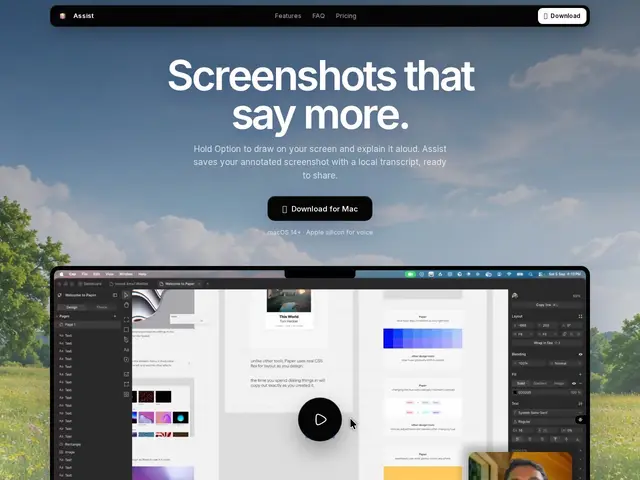
The short version: SeenShot is a solid, cheap upgrade over macOS's built-in screenshot tool specifically for annotation and quick link-sharing, and $29/year is low enough that the free tier's watermark is easy to just pay to remove.
Against macOS's native screenshot tool (Cmd+Shift+4), which has no built-in annotation or link-sharing, SeenShot adds real value for anyone who regularly explains something visually — support tickets, bug reports, quick tutorials. Against CleanShot X, a more established and feature-rich competitor in the same space (video recording, scrolling capture, more advance…
👥 Target audience
Utilisateurs et équipes Mac ayant besoin de capturer, annoter et partager rapidement des captures d'écran
The short version: evoboard's real edge over most habit trackers is the automatic logging — if the habits you care about already happen inside GitHub, Duolingo, or Chess.com, you get a genuinely honest streak without any manual check-in to forget.
Against general habit trackers like Habitica or Streaks, which rely almost entirely on manual daily logging, evoboard's app integrations are a meaningfully different mechanic — the data reflects what you actually did, not what you remembered to tap. Against GitHub's own contribution graph, which only covers code, evoboard extends the same visual ide…
👥 Target audience
Particuliers cherchant à construire des habitudes et suivre leur régularité (fitness, apprentissage, créativité)
🌍 Target countries
Marché anglophone international
🗣️ Available languages
EN
🔄 Alternatives
HabiticaStreaksGitHub (graphe de contributions natif)
The short version: Tray.bio does one thing — a fast, clean link grid — and does it without the bloat that's accumulated in Linktree and its imitators over the years.
Its real appeal is speed and simplicity: being built in Rust gives it a performance edge that JavaScript-heavy competitors can't easily match, and the minimal feature set means there's nothing to configure beyond arranging your links. The catch is that it's an early-stage project — pricing wasn't confirmed at the time of review, the site briefly returned a server error during verification, and it doesn't yet have the analytics, c…
👥 Target audience
Créateurs de contenu, influenceurs sur les réseaux sociaux, freelances et petites entreprises cherchant un agrégateur de liens léger.
🌍 Target countries
Marché anglophone, créateurs et réseaux sociaux internationaux
The short version: anVendor is a niche but genuinely useful tool for B2B sales teams who want to find companies already paying for a competitor's product, as long as the credit-based pricing fits how much prospecting you actually do.
Its real edge over classic tech-detection tools like BuiltWith or Wappalyzer is claiming live, evidence-based subscription detection rather than inferring technology from source code, which in theory catches active paying customers rather than sites that merely embedded a script once. That's a meaningful upgrade if your sales motion is "find people already spendi…
👥 Target audience
Équipes commerciales, business developers et chercheurs en intelligence concurrentielle ciblant les clients d'un vendeur SaaS précis
The short version: Macro Docs is a genuinely capable, AI-native take on collaborative markdown editing, but its value is tied to buying into the full Macro platform — and at $40/seat/month, that's a real commitment compared to free-tier-friendly competitors.
Against Notion or Coda, Macro Docs' pitch is narrower but sharper: it's markdown-native (so content is portable, not locked into a proprietary block format), and it treats AI agents as first-class collaborators with visible cursors rather than a bolted-on chat sidebar. Against Google Docs or Confluence, it's a much younger product with fa…
👥 Target audience
Équipes qui veulent une documentation collaborative en temps réel, organisations déployant des agents IA pour la rédaction/révision de documents, utilisateurs et développeurs qui préfèrent le markdown
The short version: Noisely is a genuinely useful, affordably priced way to stop manually checking a dozen review sites and support inboxes — its 22+ source coverage is broader than most Reddit-specific competitors, and $49/month for unlimited seats is a fair price for a small team.
Where Threadlytics or Octolens focus on brand monitoring for marketing (public perception, competitor share of voice), Noisely is built for product teams — its output routes into Linear and Jira, not just a dashboard, which matters if your goal is turning feedback into fixed bugs and shipped features rather than PR…
👥 Target audience
Équipes produit SaaS, petites structures et fondateurs voulant centraliser le feedback client multi-canal
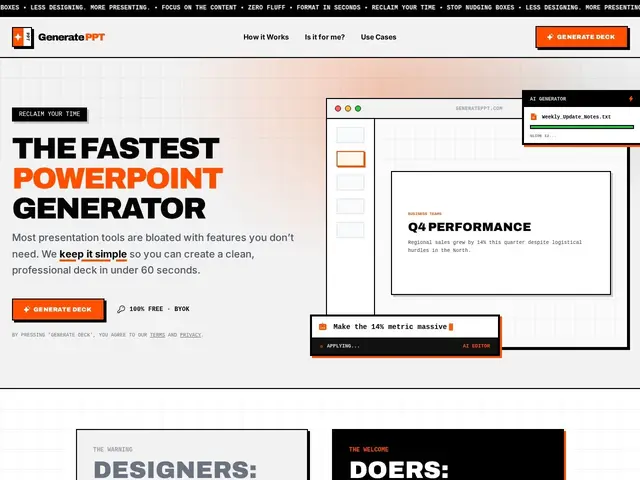
The short version: SlidesPilot is genuinely useful specifically for the "I have a document, I need a deck" conversion job, which is a narrower and more concrete promise than most general AI presentation makers.
Against general AI presentation tools like Gamma or Beautiful.ai, which mostly generate slides from a topic prompt, SlidesPilot's real differentiator is source conversion — feeding it an existing PDF, Word file, or even a YouTube video and getting a deck built from that specific content, not just a generic outline. Against manually rebuilding a deck yourself in PowerPoint, the time sav…
👥 Target audience
Analystes, enseignants, consultants, équipes commerciales devant transformer un document source en présentation
🌍 Target countries
International
🗣️ Available languages
EN
🔄 Alternatives
GammaBeautiful.aireconstruction manuelle sous PowerPoint
The short version: if your job requires regularly reporting what you worked on, Meridian automates the annoying part — remembering and writing it up — for free, as long as you're comfortable with a background activity tracker running on your machine.
Against a plain time-tracking app like Toggl, Meridian's differentiator is that it doesn't just log hours against a manually selected project — it reconstructs and summarizes what you actually did from screen activity, then drafts the update text itself. Against writing your own standup notes from memory, the honest comparison is accuracy versus …
👥 Target audience
Développeurs et travailleurs du savoir devant documenter leur activité (standups, reviews, tickets Jira)
The short version: FLOWN is worth trying if working entirely alone doesn't get you into flow, and the idea of quietly working alongside others on video actually appeals to you — it's a very specific format, not for everyone.
Against a generic virtual coworking app, FLOWN's differentiator is the neuroscience framing and structure: live facilitation and planned recovery breaks, plus explicit ADHD and procrastination positioning, rather than just an open video room. Against just using a Pomodoro timer alone, the entire value proposition is social accountability — body doubling only works if bein…
👥 Target audience
Personnes avec TDAH ou procrastination chronique, travailleurs à distance cherchant structure et accountability
The short version: BrowserNotes is a good fit if the main thing you want from a notes app is privacy and zero setup, not cross-device sync or collaboration.
Against cloud-first note apps like Notion or Google Keep, the appeal is the complete absence of an account and server-side storage — nothing to leak, nothing to subscribe to, and it works offline by default. The trade-off is the same point: without a server, there's no built-in sync between your laptop and your phone, so it suits a single-device habit more than a workflow spread across devices. It's entirely free, supported only by an opt…
👥 Target audience
Utilisateurs cherchant un bloc-notes rapide, privé, sans compte ni cloud
The short version: if you regularly switch between a few distinct window setups — 'coding mode,' 'meeting mode,' 'writing mode' — and re-arrange windows by hand every time, Tiles' one-time $4.99 price pays for itself the first week.
macOS's built-in Stage Manager attempts something similar but is aimed at grouping windows automatically rather than letting you define and instantly recall a specific named layout on demand, and many people find Stage Manager's automatic behavior more disruptive than helpful. Tiles is a much smaller, more predictable tool: you decide the layout, you decide the sh…
👥 Target audience
Utilisateurs macOS jonglant entre plusieurs configurations de fenêtres
The short version: for anyone who needs to merge, convert, or edit a PDF and doesn't want to upload it to iLovePDF or Smallpdf's servers to do it, BentoPDF does the same job locally in your browser, for free.
Compared to iLovePDF and Smallpdf, which are more polished and heavily monetized with ads, subscriptions, and file-size limits on the free tier, BentoPDF trades some visual polish for genuinely unlimited free use and a real privacy story — your files stay on your machine. Compared to desktop apps like Adobe Acrobat, it obviously doesn't match Acrobat's depth of features, but it covers th…
👥 Target audience
Toute personne ayant besoin d'éditer des PDF sans les envoyer sur un serveur tiers
The short version: if you're a Windows user drowning in screenshots and don't want another app phoning your photos home to the cloud, ImageSage's local-only approach to visual search is a straightforward, free fix — as long as you're comfortable with a tool that doesn't yet have a public track record.
The obvious comparison is Windows' own File Explorer search (which can't understand image content) and cloud photo managers like Google Photos, which offer similarly smart search but only after uploading your images to Google's servers. ImageSage's pitch — real visual/OCR search that never leave…
👥 Target audience
Utilisateurs Windows avec de grandes bibliothèques de captures d'écran/photos non organisées, soucieux de confidentialité
🌍 Target countries
International
🗣️ Available languages
EN
🔄 Alternatives
Google PhotosWindows File Explorer searchApple Photos
The short version: It's a Plan is a solid self-hosted Linear/Jira alternative on its own, and its AI-agents-as-teammates angle is a genuinely forward-looking feature if you're already delegating real work to coding agents, but it's early (393 stars) and asks you to trust a newcomer with your project data.
Linear and Jira are far more polished and battle-tested for pure human project management, and Plane is the closer open-source, self-hosted comparison; It's a Plan's differentiator is baking AI agent participation into the core model rather than bolting it on via integrations. No per-seat fe…
👥 Target audience
Équipes dev et produit voulant un PM auto-hébergé avec agents IA intégrés