Gatus
Self-hosted status-page and uptime monitor configured entirely as YAML in Git, so checks live in version control like everything else.
🔗 Visit Gatus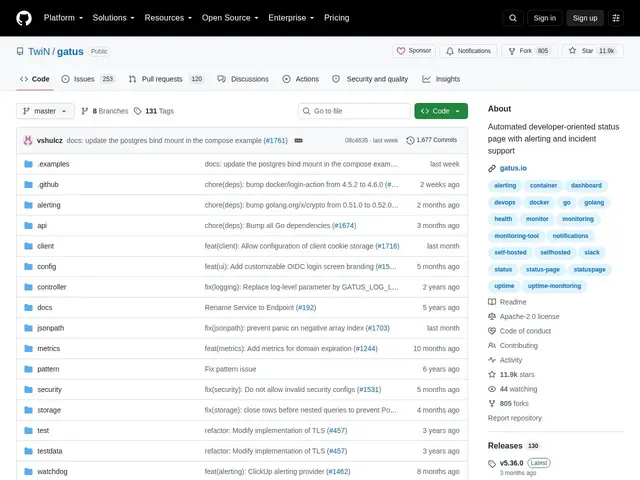
Description
Most monitoring tools want you to click through a web UI to set up every check, which works fine until you need to review who changed what, or replicate the exact same setup on a second server. Gatus takes a different approach: every monitor, alert, and status page is defined in a YAML file, so it lives in Git alongside the rest of the infrastructure code, reviewable in a pull request like anything else.
Gatus is a self-hosted, open-source health monitoring and status-page tool aimed at development and DevOps teams who want their monitoring configuration to be version-controlled infrastructure-as-code rather than clicks in a dashboard. It handles automated uptime tracking, incident and alert management, and generates a public or internal status page, all driven by the same YAML config. It deploys via Docker, is Apache-2.0 licensed, and has built up a substantial community with nearly 12,000 GitHub stars.
💬 Our review
The short version: Gatus's YAML-as-config approach is the real differentiator — for a team that already manages infrastructure as code, defining monitors the same way instead of through a separate web UI is a genuine workflow improvement, not just a preference.
Against Uptime Kuma, the most popular self-hosted uptime tool, Gatus trades Kuma's point-and-click web UI for Git-reviewable YAML configuration, which suits teams with an existing IaC/GitOps workflow far better than individuals wanting a quick web-based setup. Against Checkmate, which leans into a modern dashboard and broader monitor types (Docker, game servers), Gatus stays narrower and more config-driven. Nearly 12,000 GitHub stars is a strong signal of an actively used, trusted project for a self-hosted tool in this category. It's a strong pick for a DevOps team that wants monitoring config to live in version control next to the rest of their infrastructure; anyone wanting to configure checks by clicking through a UI will likely prefer Uptime Kuma.
💰 Pricing
📊 Global score
🤖 AI-enriched data
Auto-hébergé gratuit, licence Apache-2.0
Pros
Configuration entièrement en YAML versionnable
Gratuit et open-source, aucun palier payant
Génère des pages de statut automatiquement depuis la config
Communauté active et établie (~12 000 étoiles GitHub)
Cons
Aucune interface web pour ajouter des moniteurs, YAML uniquement
Nécessite auto-hébergement et maintenance
Moins de types de moniteurs que Checkmate