StatusScout
Open-source security and uptime monitoring that scans for missing security headers, expiring SSL certs, exposed secrets, and downtime.
🔗 Visit StatusScout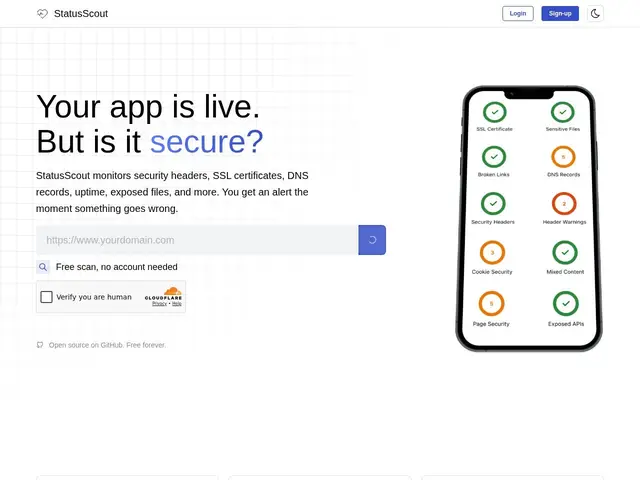
Description
Launching a website is easy; knowing whether it's actually secure and staying up is harder — most site owners find out about an expired SSL certificate or a leaked API key only after something breaks or a security researcher emails them. StatusScout runs continuous checks in the background and tells you the moment something's wrong: your site is down, your SSL certificate is about to expire, a critical security header is missing, or a config file with real secrets in it is sitting exposed on the public internet.
StatusScout is open-source and self-hostable, monitoring uptime 24/7, SSL certificate expiration, browser security headers, subdomain takeover risks (SPF/DKIM/DMARC), exposed secrets and config files, and scheduled tests of key user flows like signup or checkout. It works on any stack or framework and sends alerts via email, SMS, or ntfy. It offers a free scan with no signup required, a free-forever self-hosted tier, and paid managed hosting starting at $19/month for teams that don't want to run it themselves.
💬 Our review
The short version: StatusScout bundles several checks (uptime, SSL, security headers, exposed secrets, subdomain takeover risk) that most people otherwise juggle across three or four separate tools, and the combination of a genuinely free self-hosted tier plus a no-signup free scan makes it very low-friction to try.
Compared to point solutions — a dedicated uptime monitor like UptimeRobot, a separate SSL checker, and a separate header-scanning tool — StatusScout's value is consolidation: one dashboard, one alerting setup, covering security posture and availability together. Self-hosting is free forever (you only pay for your own server), which is a strong offer for technically comfortable teams; the $19-35/month managed tiers are reasonable for agencies or freelancers managing multiple client sites who don't want the hosting overhead. It's a newer, smaller product than the specialized leaders in each individual category, so if you need the single deepest uptime-monitoring feature set specifically, a dedicated tool may still edge it out — but for a broad security-and-uptime safety net, StatusScout covers a lot of ground in one place.
💰 Pricing
📊 Global score
🤖 AI-enriched data
Free self-hosted; $19-35/month managed
Pros
Combines uptime + SSL + security header + secret scanning
Free forever self-hosted
No-signup free scan
Multi-channel alerting
Cons
Newer/smaller than dedicated monitors
Self-hosting overhead
Plan limits on sites and test flows