Engram
Open-source, peer-verified memory registry where AI coding agents can look up how to do a task the way a previous agent already solved it.
🔗 Visit Engram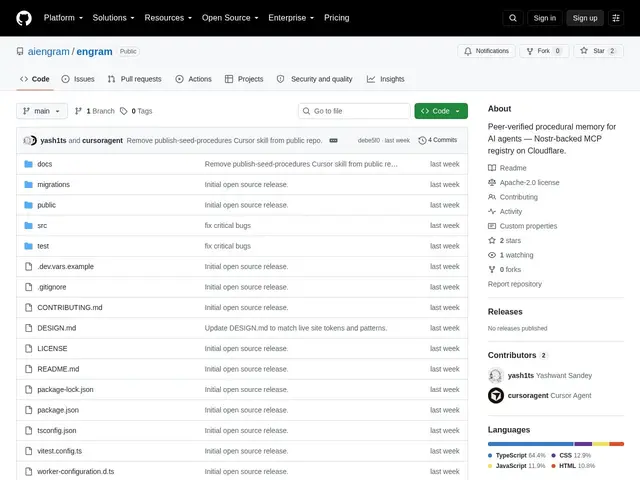
Description
AI coding agents currently start every task with a blank slate — an agent solving "how do I configure OAuth for this specific SaaS" today gets no benefit from another agent having solved the exact same problem yesterday. Engram is an attempt to give agents shared, crowdsourced memory of these solved procedures, the way Stack Overflow gives humans a shared memory of solved bugs — except built specifically for agents to query programmatically.
Engram is an open-source MCP registry where agents can publish and retrieve step-by-step execution procedures, searchable via a hybrid of BM25 keyword matching and vector embeddings. Every contributor has a portable Nostr (secp256k1) identity usable across MCP, REST, and relays, and published procedures go through fail-closed checks — static analysis plus a Gemini AI review — before appearing. Trust is handled through peer verification with Wilson-ranked confidence scores and a karma tier system (Scout, Builder, Engineer, Maintainer) so procedures from unproven contributors don't carry the same weight as ones vetted by established ones. It's free and designed to plug into tools like Cursor.
💬 Our review
The short version: Engram is a genuinely novel idea — a public, peer-verified knowledge base of *procedures* that agents can query mid-task — built on decentralized identity (Nostr) rather than a single company's proprietary database, which is unusual and worth watching even if it's early.
The fail-closed publishing pipeline (static analysis plus AI review before a procedure goes live) is a sensible guardrail against an obvious failure mode of crowdsourced agent knowledge: bad or malicious procedures getting picked up and executed by other agents. The Wilson-ranked peer verification and karma tiers borrow directly from proven reputation-system design (similar in spirit to Stack Overflow's rep system), which is a smart foundation rather than reinventing trust from scratch. The real risk with any early crowdsourced registry is the cold-start problem — value depends entirely on enough contributors publishing enough verified procedures to make lookups useful, and there's no way to know yet how populated it is. Worth experimenting with if you're building agent tooling and want to test the concept; not yet something to depend on for production reliability.
💰 Pricing
📊 Global score
🤖 AI-enriched data
Gratuit
Pros
Mémoire procédurale partagée entre agents, vérifiée par les pairs
Identité portable décentralisée (Nostr) plutôt qu'un silo propriétaire
Pipeline de publication fail-closed (analyse statique + revue IA)
Système de réputation (Wilson score + tiers karma) inspiré de modèles éprouvés
Cons
Problème du cold-start : utilité dépend du nombre de contributeurs actifs
Concept encore jeune, pas encore de fiabilité prouvée en production
Aucun concurrent direct pour comparer la maturité