Shaide
Self-hosted AI platform for distributed, multi-model LLM inference on Kubernetes clusters with single-command installation and air-gapped deployment support.
🔗 Visit Shaide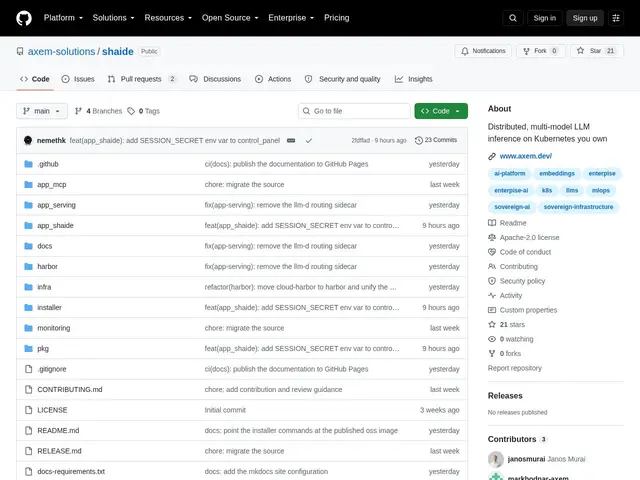
Description
Some organizations — banks, defense contractors, government agencies — simply aren't allowed to send their data to an outside AI provider's servers, no matter how convenient that would be. For them, running AI models entirely on their own infrastructure isn't a preference, it's a requirement. Shaide packages up everything needed to do that on Kubernetes into one installable platform, instead of forcing a team to bolt together a dozen separate open-source projects by hand.
Shaide is a self-hosted, Kubernetes-native platform for distributed, multi-model LLM inference, combining vLLM and llm-d orchestration, an OpenAI-compatible API, and infrastructure-as-code deployment via Pulumi into a single-command installer. It supports AWS EKS, GCP GKE, Azure AKS, and on-premises RKE2, with full air-gapped deployment for environments that can't reach the public internet at all, targeting regulated industries, defense, and public-sector organizations with strict data-residency requirements.
💬 Our review
The short version: Shaide's value isn't a novel inference engine — it's assembling the inference engine, orchestration, gateway, and infrastructure code that regulated organizations would otherwise have to integrate themselves, into one thing you can actually install.
Running vLLM or Triton Inference Server bare gets you a fast inference engine, but not the surrounding orchestration, multi-cloud infrastructure code, or air-gapped deployment story that a compliance-driven organization needs; Shaide's differentiator is bundling all of that with zero external dependencies. Compared to Ollama, which is excellent for single-node local inference, Shaide targets a completely different scale: distributed, multi-model serving across a Kubernetes cluster for an organization, not a single developer's laptop. It's Apache-2.0 and free, but that also means no vendor support contract — an organization adopting it for defense or financial workloads will need in-house Kubernetes and MLOps expertise to run it in production, not just to install it once.
💰 Pricing
📊 Global score
🤖 AI-enriched data
Gratuit, licence Apache 2.0, installeur en une commande, aucune offre commerciale.
Pros
Plateforme complète clé en main sur Kubernetes, zéro dépendance externe
Déploiement air-gapped total pour environnements isolés
Multi-cloud (AWS EKS, GCP GKE, Azure AKS) et on-premise (RKE2)
API compatible OpenAI, infrastructure-as-code via Pulumi
Gratuit et open source (Apache 2.0)
Cons
Nécessite une réelle expertise Kubernetes/MLOps en interne
Pas de support commercial officiel
Complexité disproportionnée pour un usage mono-développeur