Nosedive
Transform a notes repository into a central coordination hub that orchestrates work across multiple repositories with executable completion checks.
🔗 Visit Nosedive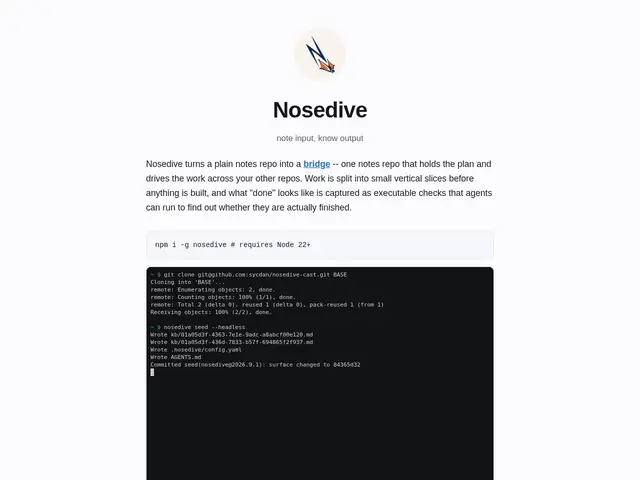
Description
Teams that now delegate coding tasks to AI agents often run into a new problem: the agent says a task is "done", but there's no reliable way to check that automatically, and the plan for the work is scattered across chat logs, docs, and multiple codebases. Nosedive is a small open-source tool that turns a simple notes repository into a coordination layer: you write down what needs to happen, break it into small pieces, and attach an actual runnable check to each piece so an AI agent — or a human — can prove the work is really finished, not just claimed to be.
Concretely, Nosedive converts a plain notes folder into a "bridge" structure that links to and coordinates work across multiple separate repositories, letting a team plan centrally while still shipping to many codebases. Each unit of work is a small vertical slice with an executable completion check attached, so task verification isn't a matter of trusting an agent's self-report. It ships as an installable npm package and is free, open source, and MIT-licensed, aimed squarely at development teams already using AI agents for parts of their workflow and needing a lightweight way to keep multi-repo work honest and coordinated.
💬 Our review
The short version: Nosedive is a free, open-source answer to a problem that's only become real in the last year or two — how do you actually verify an AI agent finished a task, across more than one repo — and it solves it with a refreshingly low-tech idea (checks you can run, not vibes you have to trust).
The vertical-slices-plus-executable-checks pattern is sound engineering discipline that predates AI agents, but pairing it with multi-repo "bridge" coordination is a genuinely useful twist for teams whose agent-driven work spans several codebases at once — a gap that heavier project-management tools (Linear, Jira) don't address at all, since they track status, not verifiable completion. Being free and MIT-licensed removes any real risk in trying it, though as with most young open-source dev tools, expect a smaller community and less polish than an established PM tool, and don't expect deep integrations beyond what an npm package plus notes conventions can offer. Worth trying if your team is already leaning on AI agents across multiple repos and tired of taking their word for "done"; skip it if your work lives in a single repo, where the coordination problem it solves barely exists.
💰 Pricing
📊 Global score
🤖 AI-enriched data
Entièrement gratuit, licence MIT, installable via npm
Pros
Gratuit et open source (MIT), aucun risque à l'essayer
Vérification par checks exécutables plutôt que par déclaration de l'agent
Coordonne le travail à travers plusieurs dépôts depuis un seul point central
Installation simple via npm, pas d'infra à monter
Cons
Outil jeune et de niche, communauté et documentation probablement limitées
Ne remplace pas un vrai outil de gestion de projet pour le reporting/visibilité équipe
Peu utile si le travail reste dans un seul dépôt