ArchLex
An open-source domain-specific language that turns text descriptions of AWS, GCP, and Kubernetes architecture into validated, reviewable SVG diagrams — including a version AI coding agents can call directly.
🔗 Visit ArchLex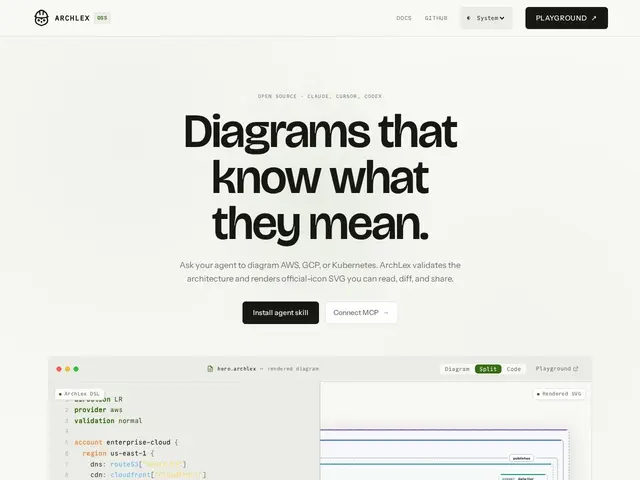
Description
Architecture diagrams usually live in a separate design tool from the actual code — someone draws boxes and arrows in a GUI app, and within a few sprints the picture no longer matches what's actually deployed. ArchLex treats a diagram more like source code: you write a short text description of your cloud setup (which services exist, how they connect, which VPC or region they live in), and the tool checks that description against real cloud rules before drawing it. Think of it like a spell-checker for infrastructure diagrams — it won't let you draw an AWS Lambda function 'writing' to a resource type that Lambda can't actually write to, and because the diagram is just text, it can be reviewed and diffed in a pull request the same way code is.
Technically, ArchLex is a DSL that renders deterministic, accessible SVG output using official AWS, GCP, and Kubernetes icons, validating resources and relationships against a catalog of 441 cloud resources with provider-aware rules for typed relationships (invokes, writes, routes, caches, etc.) and nested containment scopes (account → region → VPC → subnet). It ships as a set of modular, dependency-light npm packages (@archlex/core plus per-provider packages) usable in the browser or Node.js, plus a hosted MCP (Model Context Protocol) server so AI coding agents like Claude, Cursor, or Codex can generate or check architecture diagrams directly from a prompt. The project is MIT-licensed and fully open source on GitHub, with a free interactive playground and no account or API key required for any of it.
💬 Our review
The short version: ArchLex is a genuinely useful idea — architecture-as-text with real semantic validation — executed as a solid, free open-source tool, though it's brand new and unproven at scale.
Compared to established diagram-as-code tools like the Python diagrams library (draws cloud diagrams from code but doesn't semantically validate relationships) or Structurizr (the established C4-model architecture-as-code tool, free for basic use but oriented toward manual documentation rather than AI-agent workflows), ArchLex's real differentiator is validation plus native MCP support for AI agents — it's built explicitly so Claude, Cursor, or Codex can generate a correct diagram rather than a plausible-looking but technically wrong one. It's free, MIT-licensed, and has real documentation, a working playground, and a genuine GitHub repo with 382 commits, all good signs of a real project rather than a landing-page pitch. The catch: it launched with zero GitHub stars and no visible competing benchmarks, so its resource catalog (441 types) and validation rules haven't been battle-tested by a large community yet, and being AWS/GCP/Kubernetes-only means it won't help with Azure or on-prem architectures. For teams that already ask AI agents to reason about infrastructure, it's worth adopting now since it's free; for manual diagramming without AI involvement, Structurizr or the diagrams library are more mature choices.
💰 Pricing
📊 Global score
🤖 AI-enriched data
Fully free and open source (MIT license). Core DSL/npm packages, the hosted playground, and the MCP server are free with no account or API key required; no paid tier is advertised.
Pros
Semantic validation against 441 real cloud resources, not just freeform drawing
Native MCP server built for AI coding agents (Claude, Cursor, Codex)
Free, MIT-licensed, and fully open source on GitHub
Deterministic SVG output that stays reviewable in pull-request diffs
Cons
Brand-new project — 0 GitHub stars and no community track record at research time
Limited to AWS, GCP, and Kubernetes (no Azure or on-prem support)
441-resource validation catalog is unproven at real-world scale
Requires learning a new DSL rather than a GUI drag-and-drop workflow