TaskShell
A task manager built for the AI era — TaskShell lets Claude, ChatGPT, and Cursor read and update your tasks directly through MCP, so your AI agents and you always work from the same to-do list.
🔗 Visit TaskShell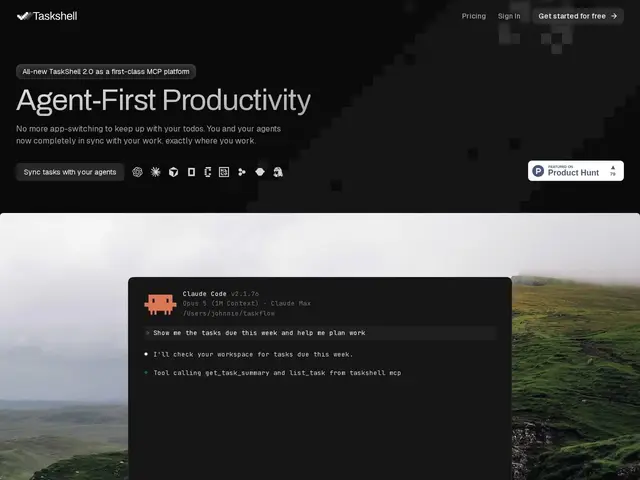
Description
TaskShell is basically a to-do list app — but built so that your AI assistants can use it too, not just you. Imagine your task list as a shared whiteboard that lives in a room you and a few very capable interns (your AI agents) all have access to: you can jot down what needs doing, and those interns can read it, check things off, add sub-tasks, or leave notes, all without you having to explain the plan to them over and over in a separate chat window. That's the core idea behind TaskShell: instead of keeping your AI tools and your task manager in separate silos where you have to manually copy context back and forth, TaskShell keeps everyone — human and AI — looking at the same live list.
Under the hood, TaskShell is built as a first-class MCP (Model Context Protocol) server, which means AI agents running in Claude, ChatGPT, or Cursor can connect to it directly and read or write tasks as part of their own workflow, rather than relying on browser automation or manual pasting. On top of that MCP layer sits a fairly conventional task manager: tasks and subtasks, workspaces, custom priority and status labels, due dates and scheduling, tags and notes, image attachments, and week/month calendar views with search and filtering. The pitch is less "another to-do app" and more "the task layer your AI agents plug into," which puts it in a fairly new category rather than going head-to-head with established productivity suites on features alone.
💬 Our review
The short version: TaskShell does one thing well — letting multiple AI agents read and update a shared task list through MCP — but as a plain task manager it's still a young, fairly basic product that hasn't proven it can compete on features once the novelty wears off.
None of the established players — Todoist, Linear, or Notion — offer anything close to TaskShell's native, first-class MCP integration; at best they have third-party MCP servers or generic APIs bolted on after the fact, so if agent-to-task-list sync is your actual bottleneck, TaskShell is currently one of the few tools built around that problem instead of retrofitted for it. That said, the core task management feature set — subtasks, priorities, tags, calendar views — is table stakes that Todoist and Linear have offered for years with far more polish, and Notion adds a full workspace/database layer TaskShell doesn't attempt to match. Pricing is the biggest open question: the homepage only promises a free tier with "full pricing not stated," which makes it hard to judge value for money against Todoist's roughly $4-5/mo Pro plan or Linear's $8-14/mo seats. Worth trying if you're already living inside Claude/Cursor/ChatGPT workflows and want your agents to actually touch your task list; not yet a safe bet if you need a mature, feature-complete system of record for a team.
💰 Pricing
📊 Global score
🤖 AI-enriched data
Get started for free; full pricing not stated on homepage
Pros
Native first-class MCP server for AI agent sync
Works across Claude, ChatGPT, and Cursor
Free tier available
Covers core task management basics (subtasks, priorities, due dates, tags)
Cons
Pricing not fully published
Very young product with limited track record
Feature set thinner than mature tools like Notion or Linear
Team collaboration depth unclear