Mental Detox
AI journaling app for anxiety, stress, burnout, and sleep problems, built on 17 evidence-based techniques (CBT, ACT, DBT, mindfulness). Voice journaling, AI mood-pattern analysis, built-in clinical self-assessment tests. iOS app only.
🔗 Visit Mental Detox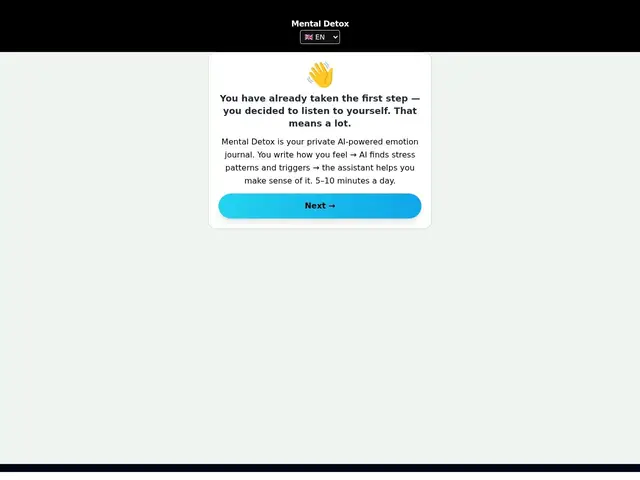
Description
Imagine a journal that texts you back: you talk or type out how you're feeling, and instead of the page just sitting there, an AI reads between the lines, notices patterns in your stress or sleep, and gently walks you through techniques a therapist might use. That's Mental Detox in plain terms — a phone app for people dealing with anxiety, stress, burnout, or bad sleep who want a daily check-in they can do on their own, between therapy sessions or before ever booking one.
Under the hood, Mental Detox is an iOS-only app built around 17 evidence-based psychological frameworks (CBT, ACT, DBT, mindfulness), offered as guided, AI-assisted journaling. It supports voice journaling for hands-free entries, runs AI-powered mood and trigger-pattern analysis over your entry history, and provides guided exercises for stress relief and an evening wind-down routine aimed at sleep. It also bundles standard clinical self-assessment instruments — the Beck Anxiety Inventory, a Burnout Test based on the Maslach Burnout Inventory (MBI), and a Sleep Quality Test — so users get a quantified baseline alongside the qualitative journaling. It's built and maintained by a single independent developer (Andriy Rukhlyadko), distributed solely through the Apple App Store, with no Android or web version and no publicly disclosed pricing.
💬 Our review
The short version: Mental Detox packs an unusually wide net of therapy-derived frameworks and real clinical self-tests into a slick AI journal, but it's a one-person iOS-only project with hidden pricing and no outcome data — a decent daily self-reflection habit, not a vetted mental-health product.
Stack it against the field and the picture gets clearer. Daylio (free, premium ~$2.99/month) is the cheap, simple mood-tracker baseline with no AI depth. Reflectly (~$59.99/year) offers similar AI-guided journaling prompts with a more established, better-funded product behind it and transparent pricing. Wysa (freemium, premium ~$99.99/year, plus enterprise/health-plan deals) is the closest real competitor in ambition — an AI CBT companion that, unlike Mental Detox, has published clinical studies backing its approach. Mental Detox's selling point is breadth (17 techniques vs. a handful) plus built-in Beck Anxiety Inventory / MBI burnout / sleep-quality tests that most journaling apps don't bother to include, and voice journaling lowers the friction of logging a bad moment in real time. But the app hides its price entirely — you can't compare value until you've already downloaded it — and it's run by a single indie developer, which is a real risk for long-term support, data handling, and whether the promised AI analysis is as rigorous as the marketing copy suggests. There's no third-party validation study, and being iOS-only cuts out most of the world's phones outright. None of these apps, including this one, are a substitute for a licensed therapist — Mental Detox is explicit that it's meant to fill gaps between sessions, not replace them, and anyone in crisis needs a human, not a journaling app.
💰 Pricing
📊 Global score
🤖 AI-enriched data
Not disclosed on the marketing site or public App Store listing; distributed as an iOS app, so pricing is presumably handled via Apple in-app purchase/subscription once installed, but no plan or amount is shown beforehand.
Pros
Broad coverage of 17 evidence-based frameworks (CBT, ACT, DBT, mindfulness) in one app
Voice journaling lowers friction for logging feelings in the moment
Built-in clinical self-assessment tests (Beck Anxiety Inventory, Burnout/MBI, Sleep Quality)
AI mood-pattern and trigger analysis over time
Dedicated evening wind-down flow specifically targeting sleep
Cons
iOS only, no Android or web version
Pricing not disclosed anywhere public before download
Built and maintained by a single independent developer
No published clinical validation or outcome studies
Not a substitute for professional therapy or crisis support