AntSeed
A peer-to-peer marketplace for AI inference that lets you buy spare AI computing power directly from other providers instead of only renting it from one big company.
🔗 Visit AntSeed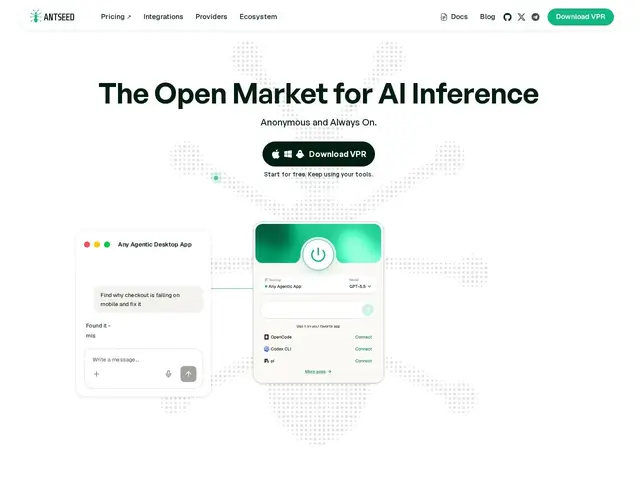
Description
If you've ever felt like you're overpaying for AI API calls even though your requests are pretty simple, AntSeed's pitch is a bit like a ride-sharing app for AI computing power: instead of everyone renting from the same few big providers, people who have spare AI capacity can sell it directly to people who need it, with the marketplace matching them up and handling payment automatically.
Technically, AntSeed is an open-source (GPL-3.0), self-hosted peer-to-peer network for AI model inference. You run a Virtual Private Router (VPR) that discovers other peers via DHT (distributed hash table) and routes requests over encrypted P2P connections, with settlement done directly in USDC — no central billing intermediary. Providers set their own per-token prices, and the network reports a median saving of around 46% versus public list prices (some providers up to 64% cheaper on specific models like Qwen). Access spans 300+ models from major labs (OpenAI, Anthropic, Qwen, Meta, DeepSeek) through dozens of active verified providers. The tradeoff for the savings and decentralization is that you're dealing with a young, thin network — no formal SLAs, provider reliability is still being established on-chain, and running it requires comfort with self-hosting a router rather than clicking 'sign up.'
💬 Our review
The short version: AntSeed's decentralized-marketplace idea for AI inference is genuinely interesting and the savings look real, but the network is still small enough that you should treat it as an experiment to run alongside a mainstream API, not a replacement for one.
Compared to centralized inference brokers like OpenRouter, Together.ai, or Replicate, AntSeed's core bet is that cutting out the middleman saves money and avoids single-vendor lock-in — and the reported ~46% median discount versus list price is a meaningful number if it holds up under real load. The catch is exactly what you'd expect from an early P2P network: no formal uptime guarantees, a small pool of active providers (dozens, not hundreds), and reputation systems that are still nascent rather than battle-tested. It's also not a one-click product — you're expected to self-host a router, which filters out anyone who isn't comfortable running infrastructure. Worth trying if you're a developer who wants to shave inference costs and doesn't mind being an early adopter; not yet something to build a production system around without a fallback provider.
💰 Pricing
📊 Global score
🤖 AI-enriched data
Pas d'abonnement : chaque fournisseur fixe son prix par token, économie médiane ~46% vs tarif public (jusqu'à -64% sur certains modèles). Auto-hébergement gratuit (open source GPL-3.0), règlement direct en USDC aux fournisseurs.
Pros
Économies réelles rapportées (médiane -46%, jusqu'à -64% sur certains modèles)
Open source (GPL-3.0) et entièrement auto-hébergeable, sans dépendance à un seul fournisseur
Accès à 300+ modèles de labs majeurs via un réseau de fournisseurs vérifiés
Cons
Réseau encore jeune (dizaines de pairs actifs), fiabilité et liquidité non prouvées à grande échelle
Nécessite un vrai travail d'auto-hébergement (routeur VPR), pas de service managé
Aucune SLA formelle, réputation des fournisseurs encore naissante on-chain