Lens AI
A knowledge layer that keeps every AI chatbot and assistant in your company answering from the same up-to-date source of truth.
🔗 Visit Lens AI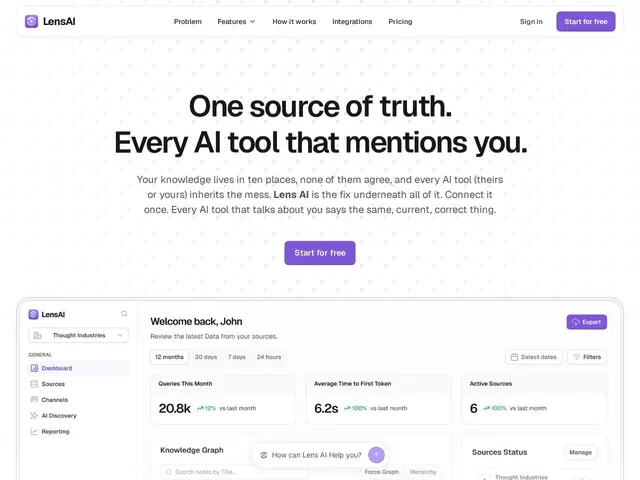
Description
Imagine your company has a support chatbot, a sales assistant, and an internal AI tool for employees — and each one gives a slightly different answer to the exact same question, because each one was set up separately and never talks to the others. Lens AI fixes that. Instead of every AI touchpoint having its own patchy memory, Lens AI gives them all one shared, always-current "brain" to draw from, so a customer, a salesperson, and an employee asking the same question all get the same correct answer.
Under the hood, Lens AI works as a knowledge layer: it connects to your dispersed sources — documents, wikis, help centers, product data, internal databases — and indexes them into a centralized workspace. From there it applies a retrieval-augmented approach to surface accurate, sourced answers, and distributes that same knowledge base out to multiple downstream systems at once: chatbots, websites, internal tools, and other AI assistants. Instead of maintaining separate knowledge silos or retraining each bot individually, teams update the source once in Lens AI and every connected system reflects the change immediately.
💬 Our review
The short version: Lens AI is a solid pick if you're tired of your chatbot, your support tool, and your internal assistant all giving different answers to the same question — it centralizes the knowledge once and pushes it everywhere, without asking anyone to write code.
Compared to Zendesk, the two aren't really solving the same problem. Zendesk is a full customer support platform with its own built-in knowledge base, ticketing, and help center — knowledge management is one feature among many. Lens AI is narrower but deeper on exactly one thing: making sure that knowledge stays consistent across every AI system that touches it, support included, but also sales bots, websites, and internal tools. If you just need a help desk, Zendesk covers it end to end. If you already have (or plan to have) several separate AI touchpoints and dread keeping them in sync manually, Lens AI is the more purpose-built tool.
Against rolling your own with the OpenAI or Claude APIs directly, the trade-off is classic build-vs-buy. Raw APIs give you full control but mean building your own ingestion pipeline, retrieval logic, and a way to keep every downstream bot updated when a source document changes — real engineering time. Lens AI trades some of that flexibility for zero-code setup and guaranteed consistency across systems out of the box. On price, $99/month for unlimited workspaces, assistants, sources, and prompts is a reasonable deal specifically if your organization already has more than one AI-powered touchpoint to keep aligned; if you only need a single simple chatbot, the free Starter tier (1,000 prompts/month) or a basic API integration will likely be enough, and paying for multi-system distribution you don't use would be overkill.
💰 Pricing
📊 Global score
🤖 AI-enriched data
Gratuit (Starter) : 1 espace de travail, 1 assistant, 1 000 prompts/mois. Pro à 99 $/mois : espaces, assistants, sources et prompts illimités, avec sauvegardes de compte.
Pros
Source de vérité centralisée pour toutes les IA de l'entreprise
Distribution automatique vers plusieurs systèmes (chatbots, sites, outils internes)
Mise en place sans code, contrairement à une intégration API sur mesure
Formule Pro illimitée à prix fixe et raisonnable
Cons
Moins complet qu'une plateforme support dédiée comme Zendesk (pas de ticketing intégré)
Limite stricte de 1 000 prompts/mois sur le plan gratuit
Moins de contrôle fin que d'orchestrer soi-même les API OpenAI/Claude