Larm
Watches your website or API from four continents at once and only pages you when the outage is confirmed from multiple locations — so a single flaky network route doesn't wake you up for a false alarm at 3am.
🔗 Visit Larm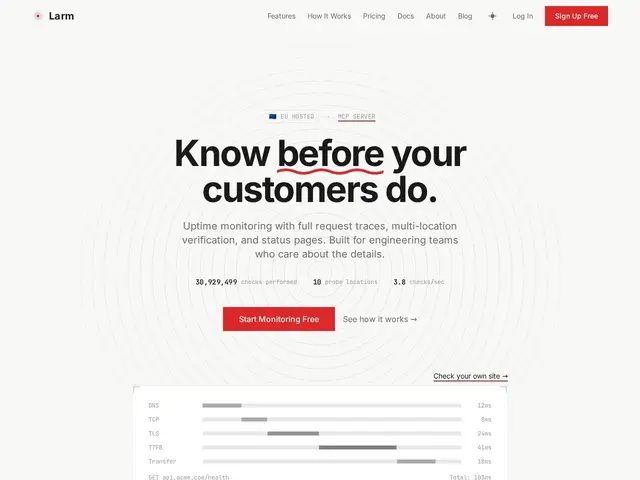
Description
The classic uptime-monitoring problem isn't detecting downtime — it's detecting it reliably. A monitor running from one location can flag your site as "down" just because of a routing hiccup between that one probe and your server, triggering a false alert. Larm checks from four continents before confirming an incident, and pairs that with full request traces (DNS, TCP, TLS, and time-to-first-byte breakdowns) so when something is actually down, you get a concrete starting point for debugging instead of just a red dot.
Beyond plain HTTP checks, it monitors TCP, DNS, and heartbeat/cron jobs, and produces branded public status pages with 90 days of history. It plugs into 14+ alerting integrations including incident.io and Grafana IRM, and tracks response-time percentiles (p50/p95/p99) over time rather than just a pass/fail state.
💬 Our review
The short version: if you've been burned by false-positive downtime alerts from a single-location monitor, Larm's multi-continent verification is the specific fix, starting free for 15 monitors and scaling to $19-49/month for more frequent checks and higher volume.
Compared to UptimeRobot (the long-running budget default) or Better Stack (a more full-featured, pricier incident-management platform), Larm sits in between: it adds the multi-location false-positive protection and detailed request tracing that basic monitors skip, without Better Stack's broader incident-management scope. For a solo developer or small team that just needs to know reliably when something breaks — and get a real trace to start debugging from — the free tier or the $19/month Pro plan is a reasonable fit; teams already invested in a full incident platform may not need a separate tool for this.
💰 Pricing
📊 Global score
🤖 AI-enriched data
Free (15 moniteurs, check/3min) · Pro $19/mois (100 moniteurs, check/1min) · Business $49/mois (500 moniteurs, check/30s)
Pros
Vérification multi-continents avant alerte, moins de faux positifs
Traces de requête détaillées (DNS/TCP/TLS/TTFB)
Monitoring multi-protocole (HTTP, TCP, DNS, heartbeat/cron)
14+ intégrations d'alerte, pages de statut avec historique 90 jours
Cons
Tier gratuit limité à 15 moniteurs et check toutes les 3 minutes
Moins riche en gestion d'incidents qu'une plateforme complète comme Better Stack
Coût qui grimpe avec le volume (Business $49/mois pour 500 moniteurs)