Stonly
A tool that turns confusing help articles into clickable, step-by-step guides customers can actually follow, so fewer people end up stuck emailing support.
🔗 Visit Stonly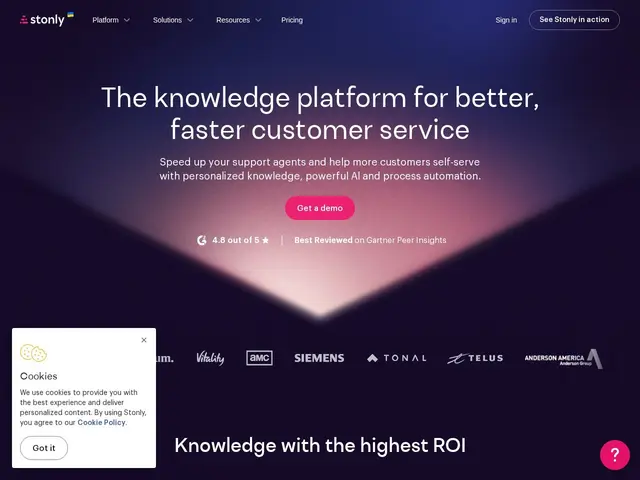
Description
Most companies write help articles the way they write a manual — one long wall of text covering every scenario at once, which means the customer has to read the whole thing to find the two sentences that apply to them. Stonly flips that: instead of a static article, you build an interactive guide that asks the customer a question, then shows only the next relevant step based on their answer, like a choose-your-own-adventure book for troubleshooting. The same guides can also power an AI chatbot and give live support agents a shortcut to the right answer mid-conversation.
Technically, Stonly is a knowledge management platform aimed at customer support organizations. Guides are built with a no-code editor and can be embedded on a website, inside a product, or surfaced through an AI-powered chatbot that answers from the same content base. It integrates with major helpdesk platforms — Zendesk, Freshdesk, Salesforce, ServiceNow — so support teams don't have to abandon their existing ticketing workflow to adopt it. Stonly reports 92% AI response accuracy and a 71% self-serve resolution rate, both self-published figures rather than independently audited numbers.
💬 Our review
The short version: Stonly is a legitimate, well-integrated interactive help-guide platform that genuinely reduces support ticket volume when guides are built well, but you can't see what it costs until you talk to sales, and the free tier is thin enough that most real teams will hit its limits fast.
Against static knowledge-base tools like Document360 or ClickHelp, Stonly's edge is the interactive, branching format — a customer troubleshooting a login issue gets asked "which error do you see?" instead of scrolling through every possible login problem. That format difference is real and measurably reduces time-to-resolution for scenario-heavy support content (password resets, setup wizards, order issues). Against full helpdesk suites like Zendesk or Freshdesk, Stonly isn't a replacement — it's a layer that sits on top of one, which is exactly why it integrates rather than competes with them. The catch is pricing opacity: the site describes a "Small Business" tier by feature (4,000 guide views/month, 1 knowledge base, 5 team members) without a dollar figure, and the free/basic tier caps out at 400 views/month and 5 published guides, which a support team with any real traffic will outgrow within weeks. Worth trialing if your support tickets cluster around a handful of repeatable, branching scenarios; less useful if your help content is mostly reference documentation that doesn't benefit from a decision-tree format.
💰 Pricing
📊 Global score
🤖 AI-enriched data
Petite entreprise (moins de 100 salariés) : 4 000 vues de guide/mois, 1 base de connaissances, 5 membres — tarif non public. Enterprise : sur devis. Essai gratuit de 14 jours. Palier gratuit très limité : 400 vues/mois, 5 guides publiés, 1 membre après l'essai.
Pros
Format interactif en arbre de décision plutôt qu'articles statiques
Intégrations natives avec Zendesk, Freshdesk, Salesforce, ServiceNow
Alimente à la fois le self-service, un chatbot IA et l'assistance aux agents
Chiffres de résolution en self-service revendiqués élevés (71%)
Cons
Aucun tarif public — contact commercial obligatoire
Palier gratuit très restreint (400 vues/mois, 5 guides)
Format arborescent moins adapté à de la documentation de référence pure