TeamGrid
Instead of paying for and switching between separate apps for tasks, CRM, invoicing, email and chat, TeamGrid bundles all of it into one workspace where everything shares the same data — a contact in your CRM is the same contact your invoice and email use
🔗 Visit TeamGrid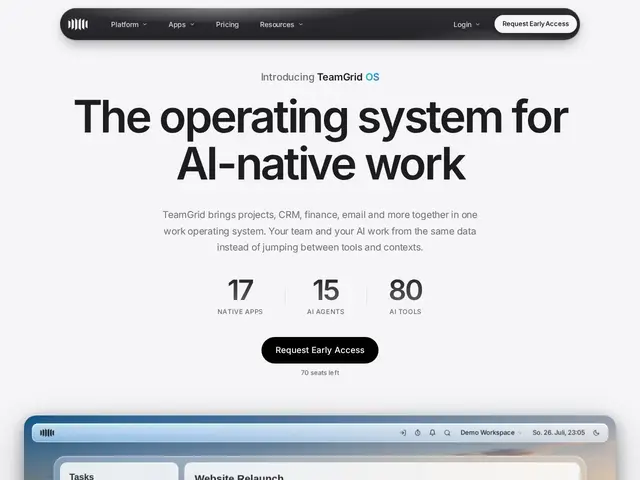
Description
A growing team often ends up with a task app, a separate CRM, a billing tool, an email client, a chat app, and a spreadsheet for planning — each with its own login, its own copy of customer data, and its own subscription. TeamGrid's pitch is to replace that sprawl with 17 native apps (tasks, projects, contacts, calendar, notes, files, messages, deal pipeline, billing, time tracking, workflows and more) on a single shared data layer, so a deal moving through your pipeline automatically shows up correctly in billing and stays linked to the right contact.
TeamGrid includes an AI Assistant built from 12 specialized agents, a visual drag-and-drop workflow builder, two-way sync with Google Workspace and Microsoft 365, and a desktop-OS-like multi-window interface. Pricing starts at $10/user/month ($8.50 annual) for the base workspace with 250 AI credits and 10GB storage, with optional add-on modules (Email $13/user/month, Workflows $18/user/month, Deal Pipeline $18/month flat, Billing $18/month flat) priced separately, plus a custom Enterprise tier for 100+ seats and a 14-day free trial requiring no credit card.
💬 Our review
The short version: for a growing team drowning in separate SaaS subscriptions that don't talk to each other, TeamGrid's consolidated shared-data-layer approach can genuinely cut both cost and context-switching — but the modular add-on pricing means the final bill needs careful comparison against what you're replacing.
Against Notion (flexible, huge ecosystem, but you build the CRM/billing logic yourself rather than getting it pre-built) or a combination of dedicated tools like Pipedrive plus Asana plus a billing app (each best-in-class at its one job, but separate data silos and separate bills), TeamGrid's edge is the shared data layer — genuinely fewer places for information to drift out of sync. The trade-off is that a jack-of-all-trades platform is rarely as deep in any single area as a dedicated specialist tool (Pipedrive's CRM depth or Asana's project views specifically), and the base price plus add-ons can approach or exceed what you'd pay for 2-3 focused tools depending on which modules you need. Worth it for a small-to-mid team that wants to genuinely consolidate and is willing to trade some depth-per-app for unified data; a team happy with its current best-of-breed stack may not gain enough from switching to justify the migration effort.
💰 Pricing
📊 Global score
🤖 AI-enriched data
Base 10$/utilisateur/mois (8,50$ en annuel, 250 crédits IA + 10 Go inclus) ; modules additionnels 2,50-18$/utilisateur/mois selon fonctionnalité ; Enterprise sur devis (100+ sièges) ; essai gratuit 14 jours
Pros
17 applications natives sur une seule couche de données partagée — pas de silos
Assistant IA avec 12 agents spécialisés inclus
Constructeur de workflow visuel par glisser-déposer
Synchronisation bidirectionnelle avec Google Workspace et Microsoft 365
Cons
Tarification modulaire qui peut vite grimper selon les modules activés
Moins profond sur chaque fonction qu'un outil spécialisé (CRM, facturation dédiés)
Migration depuis une stack existante = effort non négligeable
Éditeur plus jeune que Notion/Zoho, moins de recul long terme