Craftplan
Free, self-hosted software that helps small bakeries and craft manufacturers plan production, track ingredients, and manage orders instead of juggling spreadsheets.
🔗 Visit Craftplan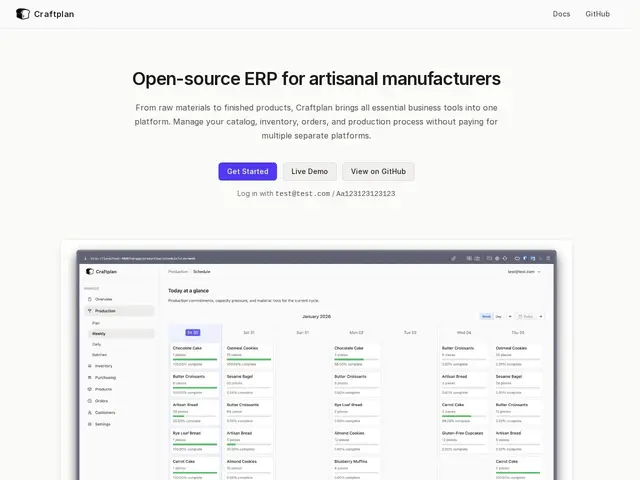
Description
A developer built this for his wife's bakery: she needed something to track recipes with real ingredient costs, know what to buy before running out, and keep orders organized, but every small-business software option either cost too much or was built for factories, not a one-person kitchen. Craftplan is the result, an open-source, self-hosted production management tool sized for artisanal and craft businesses rather than industrial manufacturers.
Craftplan is an open-source micro-ERP for small-scale artisanal manufacturers (bakeries, and by extension any made-to-order craft production business), built with Elixir, the Ash Framework, Phoenix LiveView, and PostgreSQL. It handles versioned bills of materials with automatic cost rollups, raw material inventory with lot traceability, production batch planning tied to material consumption, customer orders with calendar-based scheduling, and purchasing/supplier management, plus food-specific features like allergen and nutritional-fact tracking. It exposes JSON:API and GraphQL endpoints, supports role-based access control, and integrates with several transactional email providers (SendGrid, Mailgun, Postmark, Brevo, Amazon SES). It's AGPLv3-licensed, entirely free, self-hosted (you run it yourself, e.g. via the Docker deployment it documents), with a public demo at craftplan.fly.dev. It's a genuinely used open-source project (1.1k GitHub stars, 338+ commits) rather than a one-off toy, though as a side project born from one specific bakery's needs, expect some rough edges outside that use case.
💬 Our review
The short version: for a small food producer or craft manufacturer who's outgrown spreadsheets but doesn't want to pay for an enterprise ERP, Craftplan is a genuinely well-built, free, self-hosted option built by someone who understood the actual problem, the tradeoff is you (or someone technical) has to host and maintain it yourself.
Against a generic spreadsheet-based workflow, Craftplan's real value is the automatic cost rollup on recipes/BOMs and lot traceability, the two things that are genuinely painful to maintain by hand as a food business scales past a few products. Against paid small-business ERPs like Katana MRP or MRPeasy, Craftplan is free and self-hosted (full data ownership, no monthly fee) but demands technical setup, someone needs to deploy and maintain a Docker container, whereas the paid alternatives are one-click SaaS. It's a strong pick if you (or a technical friend or employee) are comfortable self-hosting and want zero recurring cost; it's the wrong pick if you want a vendor to call when something breaks.
💰 Pricing
📊 Global score
🤖 AI-enriched data
Gratuit, licence AGPLv3. Coût = hébergement (ex. Docker sur son propre serveur/VPS) — pas d'abonnement.
Pros
Gratuit et open-source, aucun abonnement
Cost rollup automatique sur les recettes/nomenclatures
Traçabilité par lot, suivi allergènes et infos nutritionnelles
Projet actif et utilisé (1.1k étoiles GitHub, 338+ commits)
Cons
Nécessite de savoir déployer/maintenir un conteneur Docker
Pas de support fournisseur — communauté open-source uniquement
Né d'un besoin de boulangerie précis, peut avoir des angles morts hors ce cas d'usage
Aucune date de lancement officielle publiée