Owlish
A lot of customer questions are already answered somewhere in your docs or FAQ — the problem is nobody reads them before emailing support. Owlish reads your documentation for you and turns it into a chat agent that answers customers directly, shows exactl
🔗 Visit Owlish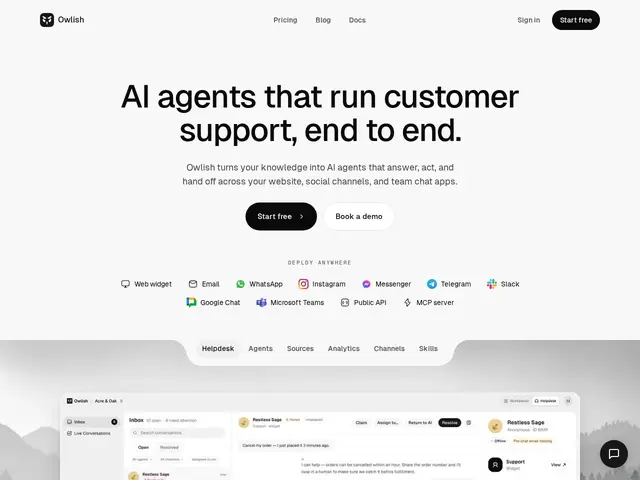
Description
Support teams spend a lot of time answering the same handful of questions that are technically already documented somewhere — the documentation exists, but customers don't dig through it. Owlish closes that gap by turning your existing knowledge base into an agent that can actually hold the conversation.
You feed Owlish your website content, FAQs and PDFs, and it answers customer questions only from what it's ingested, citing the exact passages each answer came from rather than improvising — and if the confidence threshold isn't met, or the knowledge base doesn't cover the question, it escalates to a human with the full transcript and sources attached instead of guessing. It deploys across a web widget, email, Slack, Microsoft Teams, WhatsApp, Instagram, Messenger and Telegram, and includes a shared team inbox, analytics with knowledge-gap detection, and a REST API plus MCP server. Pricing runs from a free tier (25 sessions/month, 1 agent, no human handoff) through Starter ($39/month), Growth ($119/month — the first tier with human handoff and API access), up to Scale ($359/month, 1,000 sessions, sentiment/intent detection), with add-ons for extra sessions, agents, seats and knowledge base storage. It's operated by Chevvi Pty Ltd, based in Sydney.
💬 Our review
The short version: if your support team keeps answering the same documented questions over and over, Owlish's grounded, cited answers are a safer bet than a generic chatbot because it tells you (and the customer) exactly where an answer came from instead of hallucinating one.
Against a heavyweight platform like Intercom Fin or Zendesk AI (often bundled into a much larger, more expensive support suite), Owlish's edge is that it's a focused, cheaper point solution — the free tier and $39/month Starter plan make it approachable for a small team that just wants grounded Q&A, not a full helpdesk overhaul. The catch: human handoff and API access only kick in at the $119/month Growth tier, so if escalation matters to you (and for most real support teams it does), budget for that tier rather than the entry-level ones. Solid pick for a small-to-mid support team wanting to deflect repetitive questions across chat and messaging apps; probably not a full replacement for teams that need deep ticketing workflows.
💰 Pricing
📊 Global score
🤖 AI-enriched data
Gratuit (25 sessions/mois, sans handoff humain). Starter 39 $/mois. Growth 119 $/mois (recommandé, inclut handoff humain + API). Scale 359 $/mois (1000 sessions). Add-ons à la carte. Setup accompagné : 4 999 $.
Pros
Réponses citées avec les passages sources exacts, pas d'improvisation
Handoff humain avec seuil de confiance configurable
Multi-canal : web, Slack, Teams, WhatsApp, Instagram, Messenger, Telegram
Palier gratuit exploitable pour tester (25 sessions/mois)
API REST + serveur MCP inclus dès Growth
Cons
Handoff humain et API réservés au palier Growth (119$/mois) et au-dessus
Limites de taille de base de connaissances assez serrées (0,5 Mo en gratuit)
Pas un remplaçant complet d'un vrai outil de ticketing/helpdesk