Zep
Builds a living map of everything a user has told an AI agent over time — and how those facts connect and change — so the agent can pull up exactly the right context in under 200 milliseconds instead of re-reading an entire chat history.
🔗 Visit Zep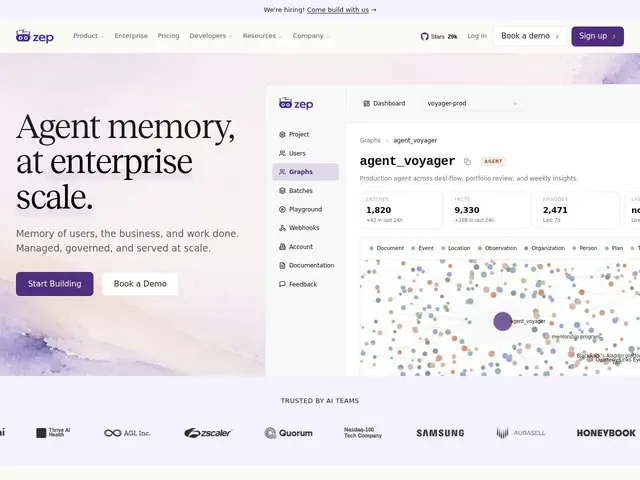
Description
Most ways of giving an AI agent memory boil down to searching for 'similar' past messages, which misses how facts actually relate to each other and change over time — a user's favorite restaurant six months ago isn't necessarily their favorite now. Zep takes a different approach, building what it calls a temporal knowledge graph: a structured map of facts and how they connect and evolve, so an agent can retrieve precisely relevant, up-to-date context instead of a pile of loosely similar text snippets.
Zep is an enterprise-focused AI agent memory platform built around temporal context graphs, founded in 2023 by Daniel Chalef and Tyler Gillson and backed by Y Combinator, Root Ventures and Engineering Capital. It claims sub-200ms context retrieval at scale via its 'Context Lake' architecture, which manages millions of context graphs for enterprise customers, and is SOC 2 Type II and HIPAA BAA certified — compliance credentials aimed squarely at regulated-industry buyers. Pricing runs Free (10,000 credits/month, 2 projects), Flex ($104/month billed annually, 50,000 credits, 5 projects), Flex Plus ($312/month billed annually, 200,000 credits, 10 projects), and Enterprise with custom credits, SLA and unlimited projects.
💬 Our review
The short version: Zep's temporal-knowledge-graph approach is a genuinely different technical bet from vector-similarity memory tools, and it matters most for agents that need to reason about facts that change over time — not just retrieve roughly similar past messages.
The trade-off is specialization: Zep is narrower than a general-purpose memory layer like Mem0, so if your agent's memory needs are simple (just recall past chat context), the temporal-graph machinery may be more sophistication than you need, and its GitHub footprint (4,770 stars) is smaller than Mem0's, reflecting a more enterprise-focused go-to-market rather than broad open-source community adoption. Its SOC 2 Type II and HIPAA BAA certifications are a real advantage for regulated buyers (healthcare, finance) that Mem0's broader positioning doesn't emphasize as strongly. Pricing on annual billing is competitive at the Flex tier, though the free tier's 10,000 credits will run out quickly for any serious testing. For teams building agents that need to track how facts about a user or entity change over time — and especially regulated-industry buyers needing HIPAA compliance — Zep's specialization is worth the switch; for general-purpose memory needs, Mem0's broader adoption and simpler mental model may be the easier default.
💰 Pricing
📊 Global score
🤖 AI-enriched data
Free : 10 000 crédits/mois, 2 projets. Flex : $104/mois (facturé annuellement), 50 000 crédits, 5 projets. Flex Plus : $312/mois (annuel), 200 000 crédits, 10 projets. Enterprise : crédits et SLA sur devis.
Pros
Graphe de connaissances temporel — capture comment les faits évoluent, pas juste leur similarité
Récupération de contexte sub-200ms revendiquée à l'échelle
Certifié SOC 2 Type II et HIPAA BAA, ciblage secteurs régulés
Cons
Plus spécialisé et moins adopté (4770 stars) que des alternatives généralistes comme Mem0
Complexité potentiellement excessive pour un besoin de mémoire simple
Tier gratuit (10K crédits) épuisé rapidement en test sérieux