turbopuffer
Vector + full-text search database built on object storage: cheap at scale, sub-10ms latency, used by Cursor, Notion and Linear.
🔗 Visit turbopuffer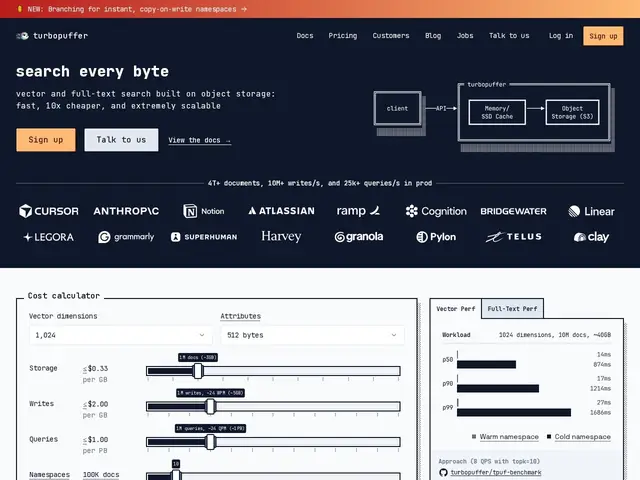
Description
AI features like 'search my notes by meaning' or a coding assistant that finds relevant code work by converting text into number sequences called vectors and searching for similar ones — this needs a specialized kind of database. turbopuffer is a hosted service that provides exactly that kind of database, built to be both fast and cheap even at very large scale, by storing data on the same cheap cloud storage regular files use instead of expensive dedicated servers.
turbopuffer is a vector and full-text search database built on object storage, aimed at AI applications that need similarity search and semantic matching alongside traditional keyword search. It combines vector search (sub-10ms p50 latency), full-text search using BM25, and hybrid search that blends both, plus metadata filtering, and scales automatically to billions of vectors. It's used in production by Cursor, Notion, Linear, Atlassian, Anthropic, Ramp, Grammarly and Superhuman, and reports handling over 4 trillion documents, 10 million+ writes per second and 25,000+ queries per second across its customer base. Deployment supports both multi-tenant and single-tenant models, with HIPAA-ready compliance and customer-managed encryption per namespace available on higher tiers. Pricing is usage-based across three named tiers (Launch, Scale, Enterprise) with no free tier.
💬 Our review
The short version: if you're building a real AI product and need fast semantic search that won't bankrupt you as data grows, turbopuffer's object-storage architecture is specifically engineered for that cost curve — and its customer list (Cursor, Notion, Linear, Anthropic) is about as strong a production reference as this category gets.
The architectural bet — object storage instead of dedicated compute for the data layer — is what lets turbopuffer claim an order-of-magnitude cost advantage at scale over incumbents like Pinecone, because you're not paying for provisioned server capacity sitting mostly idle between queries. Sub-10ms p50 latency shows that trade-off isn't costing meaningful speed. True hybrid search (vector plus BM25 in one query) matters in practice: pure vector search alone often misses exact keyword matches users expect, and bolting on a separate full-text engine adds real complexity. The customer list is unusually credible for a relatively young company — companies like Cursor and Anthropic building AI products themselves choosing turbopuffer is a stronger signal than marketing copy. Caveats: no free tier means you can't casually prototype without committing $16/month minimum, it's fully closed source and proprietary (versus self-hostable Qdrant or Milvus), and at true massive scale the per-namespace/Enterprise pricing needs real modeling. For production AI search at meaningful scale, it's a strong pick; for weekend projects or teams that need to self-host, Qdrant or Milvus remain the better starting point.
💰 Pricing
📊 Global score
🤖 AI-enriched data
Usage-based, no free tier: Launch $16/mo, Scale $256/mo, Enterprise $4,096/mo (includes 99.95% SLA)
Pros
Object storage architecture — much cheaper at scale than dedicated-server rivals
Sub-10ms p50 latency, true hybrid vector + BM25 search
Production references: Cursor, Notion, Linear, Anthropic
Cons
No free tier — $16/month minimum to start
Closed source, no self-hosting option