OpenLake
High-performance storage engine that removes I/O bottlenecks slowing down LLM inference and GPU training.
🔗 Visit OpenLake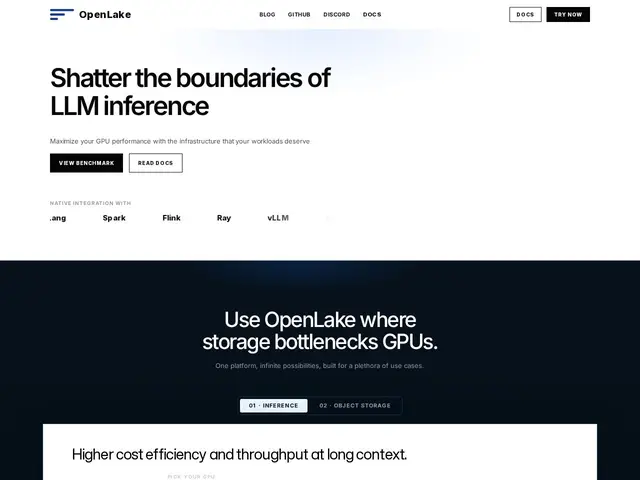
Description
Running large AI models is expensive largely because GPUs — the priciest part of the stack — spend a surprising amount of time waiting on data instead of computing. OpenLake targets that specific waste: it's a storage layer built to keep GPUs fed fast enough that they're not sitting idle during LLM inference or training.
Concretely, it offers KV-cache offloading so models can reuse previously-computed tokens across requests instead of recomputing them, plugs natively into common ML frameworks (vLLM, SGLang, Spark, Flink, Ray), and stays S3-API compatible so it can slot into existing data pipelines. For teams with the right hardware, it supports RDMA and GPUDirect for moving data straight from storage to GPU without extra hops. Pricing isn't published — the site pushes toward a sales conversation ('schedule a call for an ROI analysis') rather than self-serve signup, which fits its enterprise-infrastructure positioning.
💬 Our review
The short version: a legitimate infrastructure play addressing a real cost center (GPU idle time from storage bottlenecks) for teams running LLMs at real scale — but it's squarely enterprise-infra, with no public pricing and real hardware prerequisites.
Against running vLLM or Ray with generic storage, OpenLake's pitch is that a purpose-built KV-cache and storage layer measurably improves GPU utilization — worth real money at scale, since GPU time is the dominant cost. The catch: RDMA/GPUDirect benefits assume you already have that hardware, the framework integrations currently center on the vLLM ecosystem, and 'contact for pricing' means you can't evaluate cost without a sales call. Worth investigating if you're running LLM inference/training at a scale where GPU idle time is a real budget line; overkill for anyone not already hitting storage bottlenecks.
💰 Pricing
📊 Global score
🤖 AI-enriched data
Non publié, sur devis.
Pros
Cible un vrai coût (GPU idle time)
Intégrations natives vLLM/Ray/Spark
Compatible API S3
Cons
Prix non public
Nécessite RDMA/GPUDirect pour le plein potentiel
Écosystème d'intégration encore centré vLLM