OpenMonitor
An open-source cloud agent that keeps re-running a web search on a schedule across 13+ search providers, and pings Slack or a webhook only when something new matches your criteria.
🔗 Visit OpenMonitor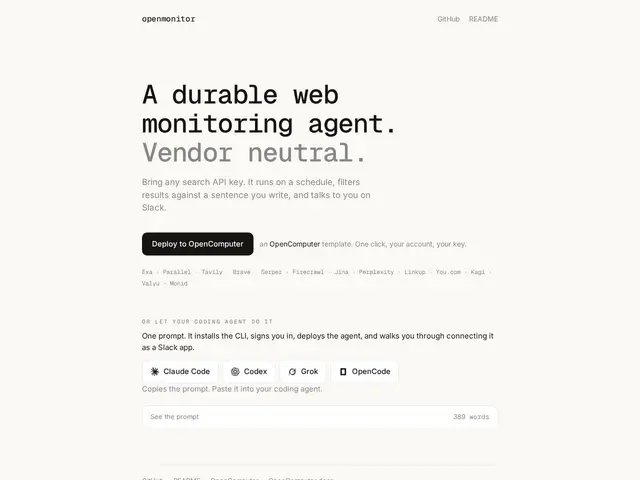
Description
Some things you need to track on the web don't fit an RSS feed or a single site's alerts — a competitor's pricing page changing, new mentions of your product, a hiring signal, a specific kind of listing appearing. The usual fix is checking manually or writing a one-off scraper, which breaks the moment the target site changes its layout. OpenMonitor turns that into a standing job: describe what you're looking for in plain language, pick which search engine should run it, and it re-runs the search on a schedule, only surfacing results that pass your filter.
What sets OpenMonitor apart from a single-vendor monitoring product is that it's explicitly provider-agnostic — it can route the same monitoring job through Exa, Tavily, Brave, Perplexity, Kagi, Firecrawl, and eight others, rather than locking you into one search backend's blind spots and pricing. Filtering criteria are written as natural-language sentences rather than regex or rigid rules, results deliver via Slack or a generic webhook, and API keys for the underlying providers stay edge-managed rather than exposed to the agent itself. It's open source (github.com/diggerhq/openmonitor, from the team behind the Digger IaC tool) and runs serverless on the OpenComputer platform, with no public pricing listed as of this review.
💬 Our review
The short version: OpenMonitor's real differentiator against single-vendor tools like Exa Monitors or Parallel Monitor is that it doesn't marry you to one search engine — you can swap providers per job without rebuilding the monitor, which matters because search quality genuinely varies a lot by use case (Kagi and Perplexity are strong for different things than Brave or Firecrawl).
Being open source and backed by Digger, an established name in infrastructure tooling, is a real trust signal for something you're going to depend on running unattended in the background — you can self-host or audit it rather than trusting a black box with your monitoring criteria. The trade-off is that provider-agnostic also means provider cost is opaque up front: your actual monthly spend depends on which of the 13 backends you pick and their own API pricing, on top of whatever OpenMonitor itself charges (not published at review time). Worth it if you already use several of these search APIs and want one scheduling/filtering/alerting layer on top instead of duct-taping cron jobs; overkill if you only need to watch one specific site, where a purpose-built change-detection tool will be simpler.
💰 Pricing
📊 Global score
🤖 AI-enriched data
Tarification non publiée ; coût réel dépend aussi du fournisseur de recherche choisi (Exa, Tavily, Brave, etc.)
Pros
Agnostique au fournisseur : 13+ moteurs de recherche interchangeables par tâche
Filtrage en langage naturel, pas de regex à écrire
Open source (backé par l'équipe Digger), auditable et self-hostable
Alertes Slack ou webhook générique
Cons
Tarification non publiée, coût réel opaque tant qu'on n'a pas choisi de fournisseur
Coût cumulé = OpenMonitor + facturation propre de chaque API de recherche utilisée
Overkill pour surveiller un seul site précis