PageIndex
A document search engine for AI that reads and reasons through a document's structure like a human would, instead of chopping it into pieces and matching by similarity like traditional RAG.
🔗 Visit PageIndex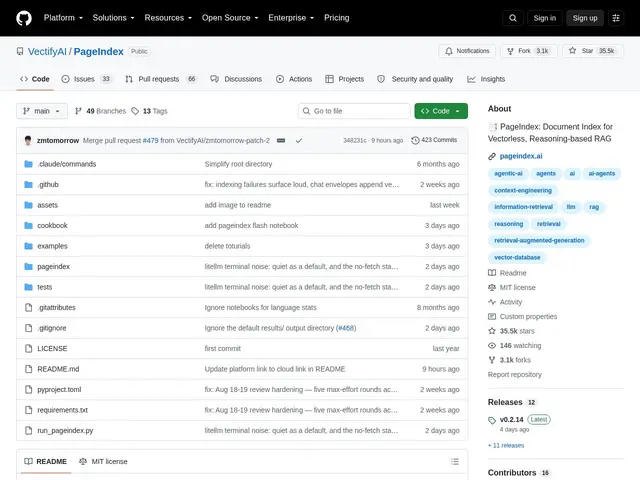
Description
Most tools that let an AI "search" a long document — a technique called RAG — work by slicing it into fixed-size pieces and finding the ones that look most similar to your question, which often misses context or grabs the wrong section on precise documents like contracts or financial filings. PageIndex takes a different approach: it builds a table-of-contents-style tree of the document and has the AI reason its way down through sections to find the right answer, the way a person would flip to the right chapter rather than skim random paragraphs.
PageIndex skips vector databases and embedding-based similarity search entirely in favor of hierarchical tree indexes navigated through LLM reasoning, and reports 98.7% accuracy on the FinanceBench benchmark versus roughly 50% for vector RAG on the same test. Indexing costs about $0.001 per page (a 1,000-page PDF costs roughly $1 in "Flash" mode), it ships Python and JavaScript SDKs that plug into frameworks like the Claude SDK and OpenAI Agents, and it's usable either self-hosted or via PageIndex Cloud's free tier, which also adds OCR and image understanding. It targets document types where precision and traceability matter most — SEC filings, regulatory and compliance documents, healthcare records, legal contracts, technical manuals — and query costs on long documents run 2-16x lower than feeding the whole PDF natively to a model.
💬 Our review
The short version: PageIndex is a genuinely different bet on RAG — replace vector similarity search with LLM reasoning over a document's actual structure — and its benchmark numbers on dense, structured documents (financial filings) are hard to ignore if precision matters more than raw speed.
Against a standard vector-database RAG stack (Pinecone, Qdrant, or a Postgres+pgvector setup), PageIndex removes an entire piece of infrastructure — no embeddings, no vector index to maintain — in exchange for LLM reasoning calls at query time, which is why it reports lower costs on long documents despite being reasoning-based rather than lookup-based. The catch is it's young: public benchmarks beyond FinanceBench are thin, documentation and worked examples are sparse, and because retrieval leans on LLM reasoning rather than a local index, you're more dependent on your model provider's availability and pricing than with a self-contained vector store. Worth adopting if you're processing structured, high-stakes documents (financial, legal, compliance) where vector RAG's precision has already let you down; stick with a mature vector-DB pipeline if you need something battle-tested with a larger community and more reference implementations.
💰 Pricing
📊 Global score
🤖 AI-enriched data
Auto-hébergé gratuit (open source) ou PageIndex Cloud : offre gratuite + ~0,001$/page indexée
Pros
Précision supérieure aux approches vectorielles sur documents denses (98,7% vs ~50% sur FinanceBench)
Élimine l'infrastructure de base vectorielle et son réglage
Préserve la structure du document, résultats traçables avec citations de pages
Coûts de requête inférieurs sur documents longs (2 à 16x moins cher qu'un PDF natif)
Cons
Benchmarks publics limités au-delà de FinanceBench
Documentation et exemples encore peu fournis
Dépendance aux appels LLM du fournisseur de modèle pour chaque requête
Communauté plus petite que les solutions de bases vectorielles établies