SkillFortify
A security scanner that formally verifies AI agent "skills" (tools/plugins) across 22 frameworks for supply-chain risks before you trust them.
🔗 Visit SkillFortify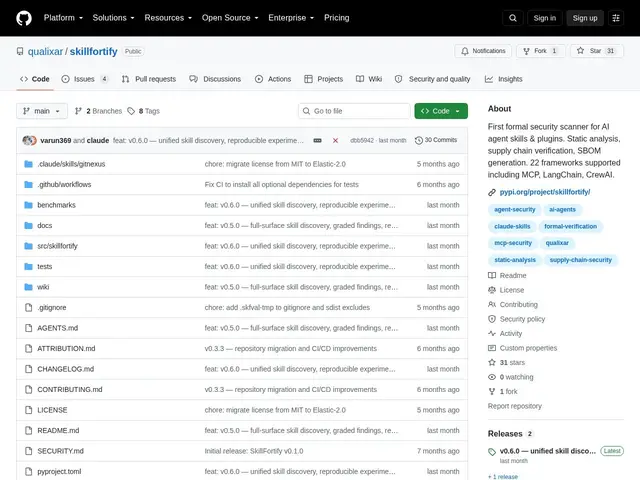
Description
When you install a browser extension, you at least get a permissions prompt telling you what it can touch. Most "skills" or plugins you add to an AI agent — a Claude Code skill, an MCP server, a LangChain tool — come with no such warning: they can read your files, call APIs, or exfiltrate data, and there's no built-in way to know which ones are safe before you run them. SkillFortify is a security scanner built to close that gap: point it at your installed AI tools and it tells you, before you trust them, whether they're doing something dangerous.
SkillFortify auto-discovers installed AI skills system-wide across 22 frameworks (Claude Code, MCP, LangChain, CrewAI, AutoGen, and others) and runs them through formal threat modeling (its own "DY-Skill" model, adapted from the Dolev-Yao protocol-verification tradition) plus static analysis, capability-based access control checks, and dependency-graph analysis. It produces interactive HTML dashboards, lockfiles for reproducible tool configurations, and AI Software Bill of Materials (ASBOM) documents for compliance. Its own benchmark, SkillFortifyBench (540 skills, 270 malicious / 270 benign), reports 100% precision but 92.59% recall — meaning it rarely flags a safe skill as dangerous, but can still miss some real threats, and its accuracy against genuinely novel (not benchmark) attacks is unvalidated.
💬 Our review
The short version: SkillFortify is a solid idea — supply-chain scanning for the AI-agent-skill ecosystem, a category that barely exists yet — but it's young enough (Elastic License 2.0, no public star count, a single maintainer visible) that you're trusting a new, narrowly-tested threat model rather than a mature security product.
Compared to general dependency-scanning tools (Snyk, Dependabot), it's the only one purpose-built for AI *skills* specifically rather than npm/pip packages, which matters since a skill often bypasses normal package-manager scrutiny entirely. Compared to just manually reviewing a skill's source before installing it — still the most common practice today — SkillFortify automates a first pass across 22 frameworks at once, a real time-saver if you're managing many agents. The catch is the license: Elastic License 2.0 is source-available, not open-source, so you can't legally offer it as a competing hosted scanning service, and 92.59% recall on a synthetic benchmark is not a guarantee against real attackers. Worth adding as an extra layer if you regularly install AI skills from third parties; not a substitute for reviewing genuinely sensitive integrations by hand.
💰 Pricing
📊 Global score
🤖 AI-enriched data
Gratuit pour usage interne, licence Elastic License 2.0 (restreint la revente en service hébergé concurrent)
Pros
Scan automatique de 22 frameworks d'agents IA en une passe
Génère dashboards HTML, lockfiles et documents ASBOM pour la conformité
Modèle de menace formel (DY-Skill) plutôt qu'une simple liste de règles
Cons
Licence Elastic 2.0 : source-available, pas open-source à proprement parler
Rappel de 92.59% sur son propre benchmark — peut manquer de vraies menaces
Efficacité contre des attaques inédites (hors benchmark) non validée
Projet jeune, pas de compte d'étoiles GitHub visible, un seul mainteneur identifié