AI Trains AI
An open-source experiment where an AI agent designs and trains its own smaller language models using reinforcement learning, for about $1,300 in GPU costs.
🔗 Visit AI Trains AI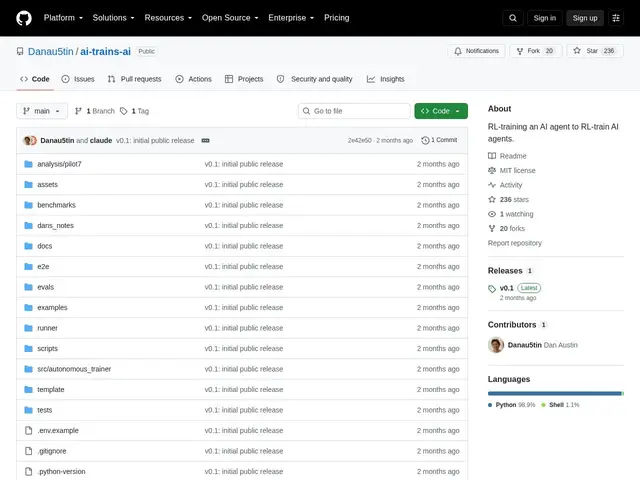
Description
Training a machine learning model normally means a human decides the architecture, the reward function, and the hyperparameters, then babysits the run. AI Trains AI flips that: it's an autonomous agent that writes its own training recipes — environments, reward functions, hyperparameters — submits them as real jobs to cloud GPUs, and learns over time to get better at designing those recipes, purely from watching whether the models it produces actually improve. It's a research demo, not a product, but it's a fully open, reproducible one that anyone can rerun for roughly the cost of the compute.
Technically, it's a nested reinforcement-learning setup: an outer loop (using Tinker's importance-sampling GRPO) trains the agent itself, based on the performance of the inner language models (Qwen 3.6B/35B-A3B bases, LoRA rank 8) it designs and submits to Runpod GPU infrastructure. Over 54 training steps the agent's reward climbed from ~0.0 to 0.63, and it developed emergent behaviors — preferring stronger base models, adapting hyperparameters to the task — without being told to. Everything (source, trained weights) is MIT-licensed and open, for a reported total cost of about $1,275. It currently only supports stateless tool-calling environments and submits one job per episode, and agent-written training code runs uncontainerized, which is a real security caveat if you fork it and let it run unattended.
💬 Our review
The short version: AI Trains AI isn't a tool you'll use day-to-day — it's a research proof-of-concept — but it's a genuinely interesting, fully-reproducible demonstration of meta-learning (an agent that gets better at training other models) done for the price of a decent laptop, and worth a look if you're curious how far RL-driven automation has come.
Against the mainstream MLOps/AutoML tooling (Vertex AI's AutoML, SageMaker Autopilot), which automates hyperparameter search within a fixed recipe, AI Trains AI goes a level deeper: the agent designs the recipe itself and improves at doing so across runs. That's a meaningfully different (and much less mature) idea — 54 training steps and one hardware target (Runpod) is a research result, not a battle-tested pipeline. It's free and open-source (MIT), so there's no financial risk in trying it, but the real cost is your own GPU budget to rerun it, and the uncontainerized code execution means you shouldn't run it against anything sensitive. Worth it for ML researchers and engineers curious about automated training-recipe design; not something to point at production model training today.
💰 Pricing
📊 Global score
🤖 AI-enriched data
Gratuit, licence MIT, code source et poids entraînés publiés ; coût de calcul du projet original ≈ 1275$ (GPU Runpod)
Pros
Idée de recherche originale : un agent qui apprend à mieux entraîner d'autres modèles
Entièrement open-source (MIT), code et poids publiés, reproductible
Résultat mesuré et documenté (reward 0 → 0.63 sur 54 étapes) plutôt qu'une simple démo marketing
Cons
Preuve de concept de recherche, pas un pipeline prêt pour la production
Exécution du code généré par l'agent non conteneurisée (risque sécurité si exécuté sans surveillance)
Ne gère que des environnements de tool-calling sans état, une soumission par épisode
Rejouer l'expérience coûte du calcul GPU réel (~1275$ dans le papier original)