Squeezed
A lightweight, single-binary audio server that streams synchronized sound to Squeezebox/Squeezelite players across your home, without needing Logitech Media Server.
🔗 Visit Squeezed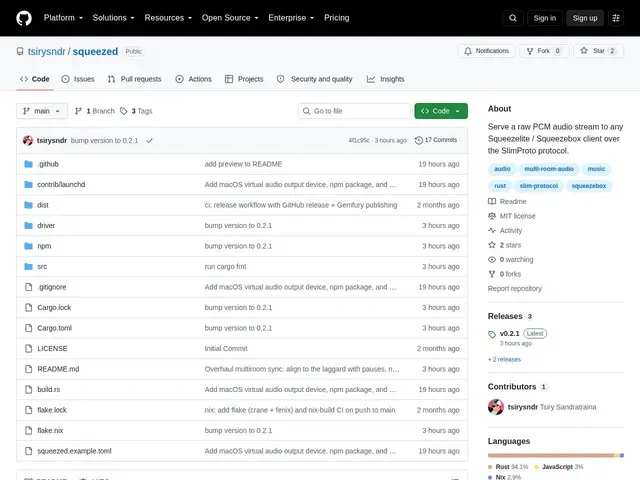
Description
If you own old Squeezebox speakers or run Squeezelite on a Raspberry Pi to play music around your house, you've probably had to install and maintain Logitech Media Server (LMS) just to feed them audio — a fairly heavy piece of software for a simple job. Squeezed replaces that: it's a small program that takes any audio you throw at it and streams it out to all your synced speakers at once, keeping them perfectly in time with each other.
Technically, Squeezed is a single static binary written in Rust that implements the SlimProto protocol used by Squeezelite/Squeezebox clients, without requiring a database, Perl runtime, or the rest of the LMS stack. It accepts raw PCM audio from stdin, named pipes, Unix sockets, TCP connections, or a macOS virtual audio device (for example piped in from ffmpeg), and distributes it to multiple players while continuously measuring and nudging each player's clock so every room renders the same sample at the same instant. Clients auto-discover the server via UDP or can connect explicitly, and configuration is done via CLI flags or TOML files. It's open source (MIT) and available via Homebrew, Nix, npm, or building from source with Cargo.
💬 Our review
The short version: if the only reason you're running Logitech Media Server is to feed audio to Squeezebox or Squeezelite speakers, Squeezed lets you drop that entire stack for a single lightweight binary — free and open source.
LMS itself remains the default, feature-complete option — it has a music library manager, plugin ecosystem, and web UI that Squeezed doesn't try to replicate. Commercial multiroom platforms like Roon go further with a polished app and metadata, but require a paid subscription and their own hardware/software ecosystem. Snapcast is the closest open-source peer, syncing audio across arbitrary clients rather than being tied to the Squeezebox protocol specifically. Squeezed's bet is narrow: keep your existing Squeezebox/Squeezelite hardware, drop the heavyweight server, and just pipe audio in from whatever source you already use (ffmpeg, a media player, etc.). Worth it if LMS's library-management features are dead weight for you; not a fit if you actually rely on LMS's library browsing and plugins.
💰 Pricing
📊 Global score
🤖 AI-enriched data
Open source (MIT), binaire gratuit via Homebrew/Nix/npm/source
Pros
Binaire unique sans base de données ni runtime Perl
Synchronisation multi-pièces précise (horloge ajustée en continu)
Sources d'entrée flexibles (stdin, FIFO, socket Unix, TCP)
Gratuit et open source (Rust, MIT)
Cons
Aucune interface web ni gestion de bibliothèque musicale (contrairement à LMS)
Nécessite un minimum de ligne de commande pour la configuration
Écosystème de plugins inexistant comparé à LMS