VLM Run Gateway
One OpenAI-compatible API that routes to 21 vision-language models for OCR, image, video and multimodal chat
🔗 Visit VLM Run Gateway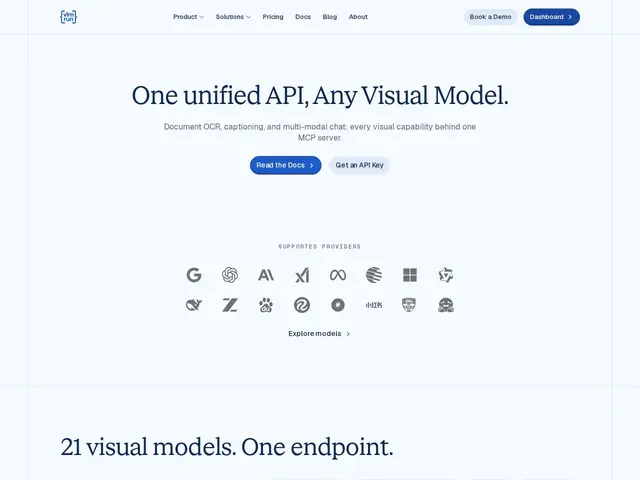
Description
Every vision AI provider — Google, OpenAI, Anthropic, Meta and others — has its own API, its own quirks, and its own bill. VLM Run Gateway puts one door in front of all of them, so switching models is a config change, not a rewrite.
VLM Run Gateway is a single OpenAI-compatible endpoint that gives access to 21 visual language models from providers including Google, OpenAI, Anthropic, xAI, Meta, Microsoft, Qwen and DeepSeek. It's built for document OCR, image captioning, video analysis and transcription, pose estimation, segmentation and multimodal chat, with automatic chunking for large inputs (500-page PDFs, 2-hour videos) and structured JSON outputs enforced by schema validation. It targets enterprises and developers building document pipelines and multimodal agents who need SOC 2 Type II and HIPAA-eligible processing without integrating each vendor's SDK separately.
💬 Our review
The short version: if you're already calling more than one vision model, a unified gateway like this removes real integration pain — the question is whether the price and complexity are worth it for your volume.
Compared to calling OpenAI's or Anthropic's vision APIs directly, VLM Run Gateway adds a layer that can meaningfully cut cost by routing to cheaper models where frontier quality isn't needed — the vendor claims $23–$90/month document-processing bills versus $938–$7.3K for pure frontier-model approaches, though that's workload-dependent. The tradeoff is pricing complexity: tiered models, service multipliers and per-tool rates make costs harder to predict up front than a flat per-token API. The $799/month Pro plan is real money for a small team, though the free tier's $10 credit is enough to prototype. Worth it once you're juggling multiple vision providers in production; unnecessary if you only ever call one model directly.
📊 Global score
🤖 AI-enriched data
Free : 0 $/mois (10 $ de crédit, 10 req/min) · Pro 799 $/mois (1000 $ de crédit inclus, 100 req/min) · tarification au token variable selon le modèle (Fast/Pro/Frontier) + tarifs fixes OCR/segmentation/vidéo · Enterprise sur devis.
Pros
Une seule API pour 21 modèles de vision, plus besoin de gérer chaque SDK fournisseur
Peut réduire fortement les coûts en routant vers des modèles moins chers selon le besoin
Chunking et traitement par lots automatiques pour les gros fichiers
Conformité mise en avant : SOC 2 Type II, HIPAA (avec BAA), SLA 99.9%
Cons
Plan Pro à 799 $/mois, cher pour une petite équipe ou un side project
Nécessite une intégration API — pas d'outil no-code pour utilisateurs non-techniques
Grille tarifaire complexe (paliers, multiplicateurs, tarifs par outil) difficile à prévoir