Context Engine
Single-tenant company memory system that pulls data from your existing tools and feeds it to AI agents
🔗 Visit Context Engine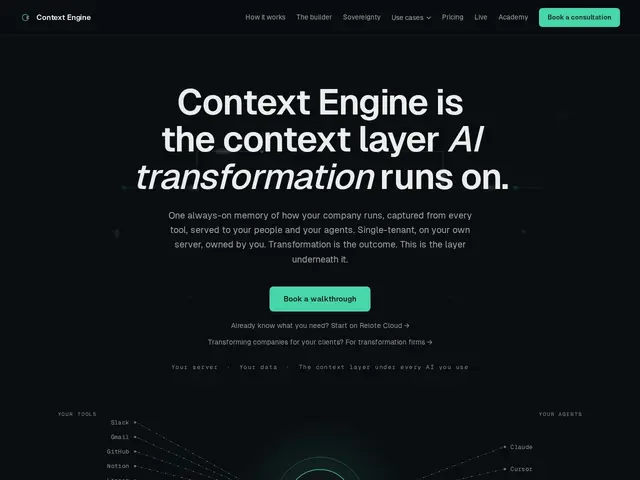
Description
AI assistants are only as useful as what they know about your company, and most of that knowledge is scattered across Slack, email, GitHub, your CRM and a dozen other tools. Context Engine's job is to pull all of that into one place that lives on your own infrastructure, then hand it to whatever AI tool you use.
Context Engine captures operational data from workplace tools — Slack, Gmail, GitHub, Notion, Jira, HubSpot, Salesforce, Zoom and more — into a centralized knowledge base for teams and AI agents. It runs as a single-tenant deployment on the client's own infrastructure rather than shared multi-tenant cloud, includes a built-in Slack/Telegram agent and a no-code workflow builder, and exposes the consolidated context to Claude, ChatGPT, Cursor and Copilot via the Model Context Protocol (MCP). Encrypted backups are held only by the client, and the architecture is built to avoid vendor lock-in with full data export.
💬 Our review
The short version: single-tenant deployment plus native MCP support is a real answer for companies that want their AI agents to have organizational context without handing that data to a shared cloud service.
Compared to building this yourself with a vector database (Pinecone, Weaviate) and LangChain glue code, Context Engine packages the integrations (15+ tools) and the deployment model for you — at the cost of no public pricing and a reported six-month minimum engagement, which puts it firmly in the enterprise-sales category rather than self-serve SaaS. Compared to Notion or Confluence as a knowledge base, it's built specifically to feed AI agents via MCP rather than for humans to browse. Worth the sales conversation if data sovereignty is a hard requirement and you have the budget/timeline for a multi-month rollout; too heavy if you just want a quick RAG setup over a few docs.
📊 Global score
🤖 AI-enriched data
Aucune grille tarifaire publique — passe par un cycle commercial. Engagement minimum de 6 mois rapporté pour l'implémentation.
Pros
Déploiement single-tenant garantissant la souveraineté totale des données
Plus de 15 intégrations avec des outils courants (Slack, GitHub, Notion, Jira, HubSpot, Salesforce, Zoom...)
Architecture pensée contre le vendor lock-in : export complet, clés de chiffrement côté client
Intégration directe via Model Context Protocol (MCP) avec Claude, ChatGPT, Cursor et Copilot
Cons
Tarification non publique, nécessite un contact commercial
Engagement minimum de 6 mois pour l'implémentation et la formation
Charge opérationnelle du déploiement single-tenant par rapport à une SaaS classique
Peu de cas clients documentés publiquement au-delà de 5 exemples