Dagic
Python workflow engine that lets LLM agents run tool calls as parallel DAGs instead of one at a time
🔗 Visit Dagic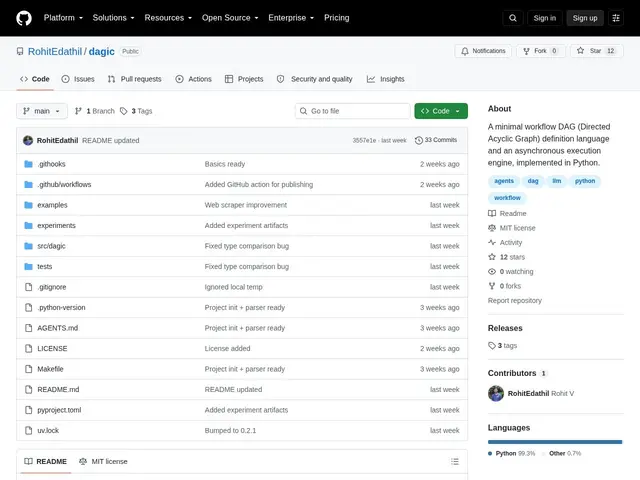
Description
When an AI agent needs to call five tools where three of them don't depend on each other, most agent frameworks still run them one after another, burning tokens and time re-explaining context at every step. Dagic gives agents a typed workflow language instead: the agent describes what depends on what, and independent branches run in parallel automatically.
It sits deliberately between two extremes — plain sequential tool calling (safe but slow) and letting the agent write and execute arbitrary code (fast but risky) — by having a host register the available operations up front, so the agent composes them into a typed, statically-checked directed acyclic graph rather than generating free-form code. It's built on Python's asyncio (Python 3.10+ required) with a minimalist syntax focused purely on expressing data dependencies. In the project's own benchmarks against sequential LangGraph agents on math-problem tasks, it reports roughly 7x fewer tokens, 3x faster execution, and 3.6x lower cost. It's MIT-licensed, free, with 12 GitHub stars and 33 commits at time of review.
💬 Our review
The short version: Dagic's core bet — typed DAGs instead of sequential calls or arbitrary code — is a genuinely sensible middle ground, and its own benchmarks against LangGraph are a meaningful (if self-reported) efficiency claim worth testing on your own workload.
Against LangGraph, the established graph-based agent framework, Dagic's pitch is narrower and more disciplined: static type-checking and host-controlled operations mean the agent can't run arbitrary code, only compose pre-registered tools — a safer default for production use, at the cost of flexibility LangGraph's broader ecosystem offers. Against CrewAI's role-based multi-agent model, Dagic is solving a different problem (parallel tool composition within one agent's workflow, not multi-agent role delegation). The efficiency numbers are compelling but come from the project's own benchmarks on a narrow task type (math problems), so treat them as a starting hypothesis to verify on your actual workload, not a guarantee.
💰 Pricing
📊 Global score
🤖 AI-enriched data
Licence MIT, gratuit.
Pros
Parallélisation automatique des branches indépendantes d'un DAG typé
Vérification de type statique avant exécution, pas de code arbitraire
Benchmarks internes : ~7x moins de tokens, ~3x plus rapide, ~3.6x moins cher vs LangGraph séquentiel
Gratuit, MIT, syntaxe minimaliste
Cons
Benchmarks auto-rapportés sur une tâche étroite (problèmes mathématiques), à valider sur son propre cas d'usage
Projet jeune (12 stars, 33 commits)
Moins flexible que LangGraph si l'agent a besoin d'exécuter du code arbitraire