mcptunnels
A one-command CLI that exposes a local MCP server to a public URL, so you can test or demo it with ChatGPT, Claude, or Cursor without deploying anything.
🔗 Visit mcptunnels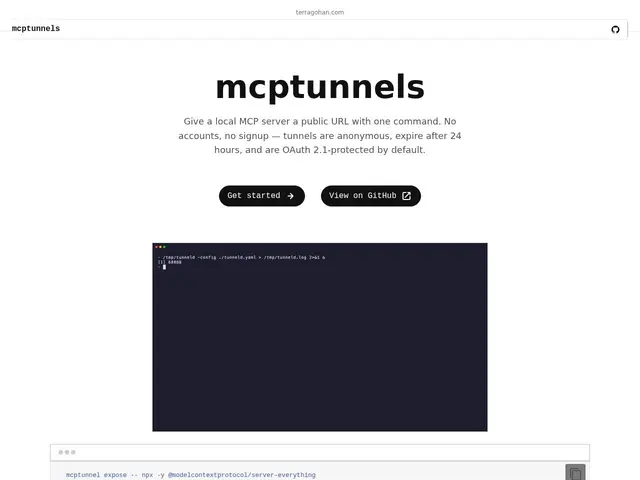
Description
If you're building an MCP (Model Context Protocol) server — the standard that lets AI assistants call tools — you normally need it reachable on the public internet before ChatGPT, Claude, or Cursor can talk to it, which usually means deploying it somewhere first. mcptunnels skips that step: run one command on your machine and it hands you a temporary public URL for your local MCP server, similar to what ngrok does for regular web servers, but purpose-built for MCP.
Under the hood it bridges stdio to HTTP, secures the tunnel with OAuth 2.1 and an auto-generated password, and issues ephemeral URLs that expire after 24 hours with immediate cleanup when the process exits — so nothing lingers on the public relay after you're done. It runs through a free, best-effort public relay (tunnel.mcptunnels.xyz) or you can self-host the relay if you need more control or reliability. It's free, open, and positions itself against general tunneling tools like ngrok, cloudflared, and bore, but tuned specifically for the MCP stdio-to-HTTP use case.
💬 Our review
The short version: if you're iterating on an MCP server and keep needing to hand a working link to a colleague or wire it into ChatGPT/Claude for a quick test, mcptunnels removes the deploy-just-to-test friction in one command, for free.
It's a narrow, well-scoped tool rather than a general tunneling replacement — you could do the same thing with ngrok or cloudflared plus a manual stdio-to-HTTP bridge, but mcptunnels bundles that specifically for MCP, which is the actual time saver. The trade-offs are the ones you'd expect from a free best-effort public relay: no uptime guarantee, 24-hour URL expiry, and you're routing your local MCP traffic through a third-party relay unless you self-host it — fine for demos and testing, not something to lean on for anything production-adjacent. It's also a young project without a large user base yet, so don't expect enterprise support. Good pick for solo developers and small teams prototyping MCP servers; skip it if you need a stable, long-lived public endpoint, in which case a real deployment (or self-hosting the relay) is the better call.
💰 Pricing
📊 Global score
🤖 AI-enriched data
Relai public gratuit en best-effort ; auto-hébergement du relai possible pour plus de contrôle
Pros
Une seule commande, zéro compte requis
Spécifiquement conçu pour le pont stdio↔HTTP du protocole MCP
Sécurisé par OAuth 2.1 avec mot de passe auto-généré
Auto-hébergement du relai possible
Cons
Relai public gratuit en best-effort, aucune garantie de disponibilité
URLs éphémères qui expirent après 24h
Projet jeune, communauté et support limités
Pas adapté à un usage production