KanVibe
Open-source Kanban board with embedded browser terminals, built for people running multiple AI coding agents (Claude Code, Gemini CLI, Codex) on parallel tasks and git worktrees at once.
🔗 Visit KanVibe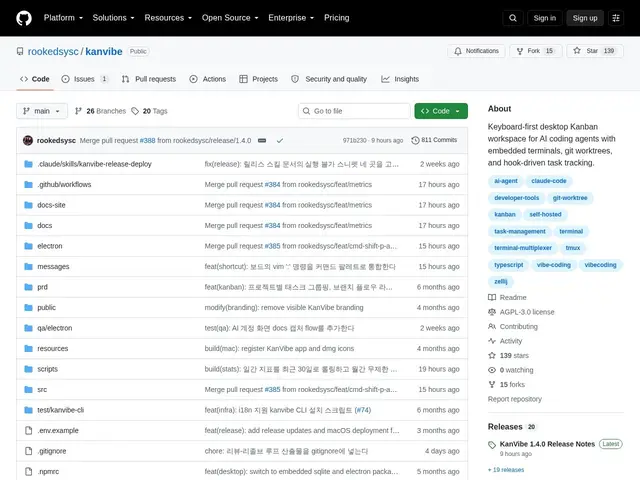
Description
If you're now running two or three AI coding agents at once, each working on a different task in its own branch, you already know the problem: too many terminal windows, and no single place to see which agent is doing what. KanVibe is a Kanban board that also embeds real terminal sessions inside each task card, so the board and the actual work live in the same window.
KanVibe is a free, open-source (AGPL-3.0) desktop and browser app combining a 5-status Kanban board (TODO, PROGRESS, PENDING, REVIEW, DONE) with tmux/zellij-backed terminal sessions rendered via xterm.js, updated in real time over WebSockets with drag-and-drop. It automatically creates and cleans up git worktrees tied to each task's lifecycle, ships hooks for Claude Code, Gemini CLI, Codex CLI, and OpenCode so agent activity shows up as live status on the board, and includes a GitHub-style diff viewer for reviewing what an agent changed. It supports SSH remote terminals with X11 forwarding detection, vim-style keyboard navigation, browser notifications on status changes, and interface localization in English, Korean, and Chinese. At the time of writing it has 139 GitHub stars and over 800 commits on main.
💬 Our review
The short version: KanVibe is a genuinely useful, free tool for the very specific (and increasingly common) problem of running several AI coding agents on parallel branches without losing track of which one is doing what.
General project-management boards like Trello or Linear have no concept of a terminal session or a git worktree — you'd still be tabbing out to a separate terminal to check on an agent. Dedicated AI-agent orchestration dashboards exist, but they tend to be either closed-source SaaS products or narrowly scoped to one agent vendor; KanVibe instead supports four different agent CLIs and is fully open source and self-hosted, so there's no subscription and no vendor lock-in. The automatic worktree lifecycle management is the standout feature — it removes a genuinely annoying manual step when juggling multiple agent branches. The catch is that it's a young, single-maintainer project (139 stars) without the polish, support, or integration breadth of a funded product, and it assumes you're comfortable with tmux/zellij and git worktrees already — this isn't a tool for someone new to either AI coding agents or terminal multiplexers.
💰 Pricing
📊 Global score
🤖 AI-enriched data
Outil open source gratuit (licence AGPL-3.0), auto-hébergé
Pros
Gratuit, open source et auto-hébergé (AGPL-3.0)
Gestion automatique du cycle de vie des git worktrees
Hooks natifs pour 4 agents IA (Claude Code, Gemini CLI, Codex CLI, OpenCode)
Terminaux tmux/zellij embarqués en temps réel dans le navigateur
Cons
Projet jeune, mainteneur unique (139 stars)
Suppose une aisance préalable avec tmux/zellij et les git worktrees
Pas de support commercial ni de SLA