AptAI
Marketplace where developers can discover, A/B test, and deploy fine-tuned LLM adapters with one click, and where model creators can host and monetize their own fine-tunes with a 70/30 revenue split.
🔗 Visit AptAI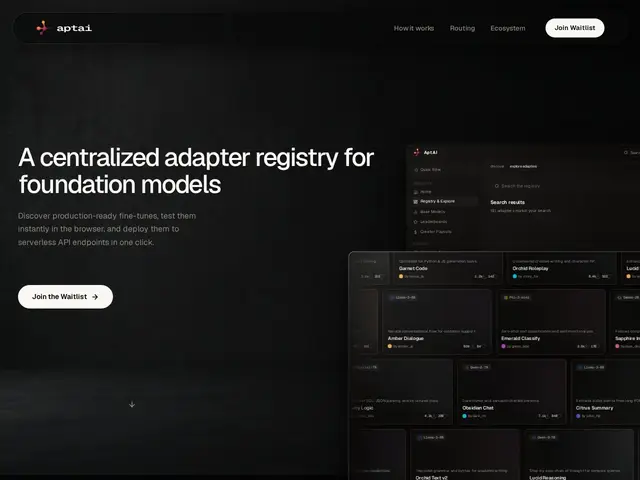
Description
Fine-tuning a language model for a specific task is one thing; actually hosting it cheaply and reliably so an app can call it is a different, harder problem most developers don't want to solve themselves. AptAI is a marketplace that handles that second part — you either pick an existing fine-tuned adapter from its catalog or upload your own, and it takes care of serving it behind a simple API.
AptAI is a centralized registry of 191+ fine-tuned LLM adapters offering one-click serverless deployment through an OpenAI-compatible API, dynamic LoRA weight-swapping with sub-millisecond latency, and zero cold-start inference routing. It includes a side-by-side A/B testing playground for comparing adapters before committing, a fine-tuning wizard with live evaluation, and IP protection so model weights are never publicly exposed. It's compatible with agent frameworks like OpenHands, AutoGen, CrewAI, and Aider. Developers pay per inference call; creators who publish an adapter keep 70% of the revenue it generates, with custom per-token pricing they set themselves. It's currently operating in private beta, first announced in late 2024.
💬 Our review
The short version: AptAI is interesting mainly for the creator side of the equation — a real, structured way to monetize a fine-tuned model without building your own serving infrastructure — and for developers, a shortcut to specialized adapters you'd otherwise have to fine-tune and host yourself.
It sits between general model-hosting platforms like Replicate or Hugging Face Inference Endpoints, which host whole models but don't specialize in LoRA adapter marketplaces, and base LLM providers like OpenAI or Anthropic, which don't let you plug in a community fine-tune at all. The zero cold-start claim and sub-millisecond adapter-swapping are the real technical differentiators if accurate — LoRA-swapping-as-a-service is a genuinely harder infrastructure problem than serving one static model. The catch is that it's still in private beta, so pricing, adapter quality, and platform stability are unproven at scale, and a 191-adapter catalog is small compared to the breadth of models on Hugging Face. Worth trying if you specifically need a niche fine-tune and don't want to run GPU infrastructure yourself; not yet a safe bet for production workloads given the beta status.
💰 Pricing
📊 Global score
🤖 AI-enriched data
Facturation à l'inférence, tarif fixé par le créateur de l'adaptateur ; partage de revenus 70/30 en faveur du créateur
Pros
Échange dynamique de poids LoRA à latence sub-milliseconde
Déploiement serverless en un clic, API compatible OpenAI
Partage de revenus 70/30 favorable aux créateurs
Playground de test A/B intégré
Cons
Encore en bêta privée, stabilité et tarifs non éprouvés à grande échelle
Catalogue de 191 adaptateurs, modeste face à Hugging Face
Dépendance à une plateforme jeune pour des charges de production