Memnest
Open-source, local-first memory service that lets AI coding agents like Claude Code and Codex remember past decisions across sessions.
🔗 Visit Memnest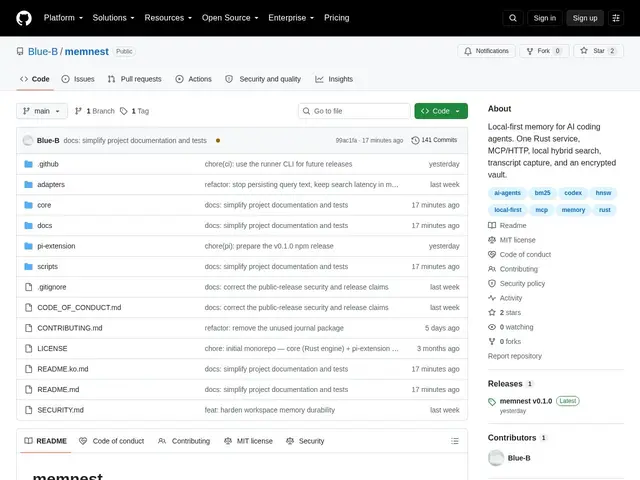
Description
If you use an AI coding assistant, you've probably run into its biggest limitation: it forgets everything the moment you close the chat. Explain a design decision today, and tomorrow's session starts from zero. Memnest is an open-source tool that gives AI coding agents a persistent memory — so decisions, corrections, and context you've already established stick around instead of being re-explained every single session.
Memnest is an open-source (MIT-licensed) local-first memory service, built in Rust, designed to be shared across multiple AI coding agents (Claude Code, the "pi" assistant, and Codex) via the Model Context Protocol (MCP) and a plain HTTP API. It uses hybrid search — combining BM25 keyword matching with vector similarity — to retrieve relevant past context, stores an AES-256-GCM encrypted credential vault, supports per-project/workspace isolation, and runs a local embedding model so no external LLM calls are needed just to store or retrieve memory.
💬 Our review
The short version: if you switch between multiple AI coding agents and are tired of each one forgetting your project's history the moment a session ends, Memnest gives them a shared, private memory layer — and because it's self-hosted and open source, that memory never leaves your machine.
The competitive set here is thin but growing fast: some coding agents ship their own built-in memory (Claude Code's project-level context, for instance), but that memory is typically locked to one tool and one vendor. Memnest's differentiator is being agent-agnostic — the same memory store works whether you're in Claude Code, Codex, or the "pi" agent — and running its own local embedding model means it doesn't leak your codebase context to a third-party embeddings API just to index it. The tradeoffs are real: it's Rust-based infrastructure you have to self-host and maintain, it's a very young project with a limited community track record, and "shared memory across agents" is a young enough category that best practices are still being figured out. Worth setting up if you regularly juggle 2+ AI coding agents on the same codebase; probably overkill if you're a single-agent, single-project user who's fine re-establishing context each session. <!-- ai-generated -->
💰 Pricing
📊 Global score
🤖 AI-enriched data
Open source (MIT), auto-hébergé, aucun coût de licence
Pros
mémoire partagée entre plusieurs agents IA (Claude Code, Codex, pi)
recherche hybride BM25 + similarité vectorielle
modèle d'embeddings local, aucun appel LLM externe requis pour indexer
coffre-fort d'identifiants chiffré AES-256-GCM
open source MIT, auto-hébergé, isolation par projet
Cons
projet jeune, communauté et documentation encore limitées
nécessite d'auto-héberger un service Rust, pas de version cloud clé en main
catégorie encore émergente, bonnes pratiques pas encore stabilisées