dataset-cleaner-cli
Open-source Python CLI that turns technical documentation into clean Q&A training datasets for LLM fine-tuning, using a local model.
🔗 Visit dataset-cleaner-cli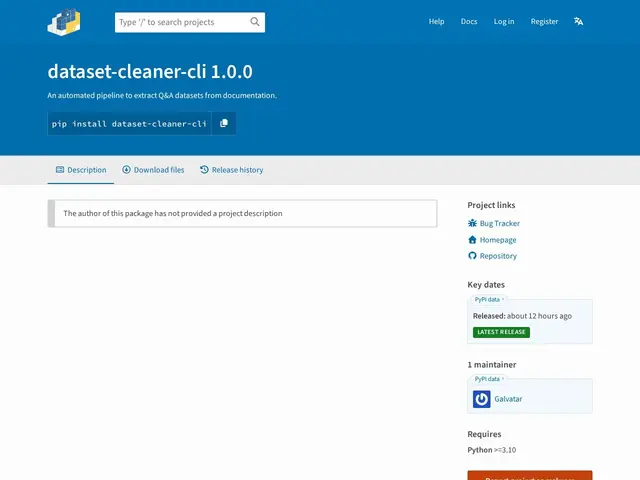
Description
If you want to fine-tune a small language model on your own documentation, the hard part usually isn't the training — it's turning messy PDFs, markdown files, and code comments into clean question-answer pairs a model can actually learn from, without either hallucinating answers or copying garbage formatting into the dataset. dataset-cleaner-cli automates that grunt work: point it at your docs, it uses a locally-running model to generate Q&A pairs, then checks each one for accuracy before it goes in the final dataset.
dataset-cleaner-cli is a Python (3.10+) command-line tool that extracts question-answer datasets from technical documentation — PDF, Markdown, TXT, CSV, EPUB, and MOBI — using a local LLM via Ollama, so no data leaves your machine and no API key is required. The pipeline parses and chunks the source documents, generates Q&A pairs locally, then validates them semantically with sentence-transformers and runs hallucination detection to filter out answers not actually supported by the source text. It uses Python's AST module to validate any code snippets it captures, and can resolve dynamic markup from FastAPI, Jinja, and MkDocs. Output formats include ShareGPT, Alpaca, OpenAI Messages, and plain text completions — the standard formats most fine-tuning pipelines expect. It's AGPL-3.0 licensed and still early-stage (5 commits as of August 2026).
💬 Our review
The short version: if you're fine-tuning a small model on internal docs and dreading the manual work of turning documentation into a clean Q&A dataset, this tool automates that pipeline end-to-end and keeps everything local — worth trying since it costs nothing, though its youth (5 commits) means you should treat the output as a starting point to spot-check, not a fully trusted pipeline yet.
Tools like Argilla or Cleanlab focus on cleaning and labeling datasets you already have, and Great Expectations focuses on validating structured tabular data — none of them go from raw documentation to a ready-to-train Q&A dataset the way dataset-cleaner-cli does. Its real differentiator is running entirely on a local Ollama model rather than calling an external API, which matters if your documentation is confidential. The tradeoff is early maturity: a 5-commit project hasn't been battle-tested at scale, and you're depending on whatever local model you run for quality, which will be more variable than a frontier hosted model. Worth it for solo developers or small teams fine-tuning on internal docs who want a free, private starting point; not yet the tool to trust blindly for a production training pipeline. <!-- ai-generated -->
💰 Pricing
📊 Global score
🤖 AI-enriched data
Open source (AGPL-3.0), aucun coût, dépend d'un modèle Ollama local
Pros
pipeline complet : parsing, génération Q&A, validation sémantique, détection d'hallucinations
tourne en local via Ollama, zéro donnée envoyée à un tiers
supporte PDF, Markdown, TXT, CSV, EPUB, MOBI en entrée
export direct en formats standards (ShareGPT, Alpaca, OpenAI Messages)
gratuit et open source (AGPL-3.0)
Cons
projet très jeune (5 commits), maturité et fiabilité à prouver
qualité du dataset dépend du modèle local choisi (variable)
nécessite de faire tourner Ollama, pas plug-and-play pour un non-technicien