BLAST
Open-source sandbox orchestration tool with one API across Docker, SmolVM, and Hypeman backends.
🔗 Visit BLAST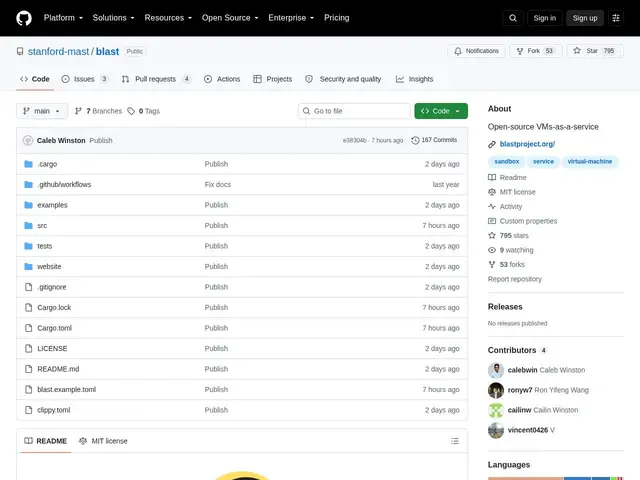
Description
Running code in an isolated, disposable environment — a sandbox — is something AI agent builders, CI systems, and security teams all need constantly, but every sandboxing tool tends to lock you into one specific backend, just Docker or just a VM. BLAST is a small tool from Stanford's MAST research group that gives you one simple command to spin up a sandbox on whichever backend you actually have available.
BLAST is an open-source sandbox orchestration layer, shipped as a single binary around 7 MB, that abstracts Docker, SmolVM, and Hypeman behind one unified API for forking and running sandboxed commands. It handles resource scheduling, snapshot persistence, and monitoring automatically, and the whole codebase is intentionally minimal, around 3,500 lines of Rust. MIT-licensed and free.
💬 Our review
The short version: BLAST is a lightweight, free way to get sandboxed command execution without hard-committing to one VM backend — useful if you're building agent infrastructure and don't want your sandboxing layer to become a lock-in point.
The obvious comparison points are Docker (container isolation, but heavier and not VM-level), Firecracker and gVisor (proper VM-grade isolation, but lower-level and more setup), and Containerd (a container runtime, not really an orchestration API). BLAST doesn't replace any of these, it sits on top of them, so you can switch backends later without rewriting your integration. Given it's free, open source, from a credible research group, and genuinely small in scope, there's very little downside to trying it if you're building anything that needs disposable sandboxes. The main caveat: at under 800 stars and still young, expect some rough edges in less common backend configurations.
💰 Pricing
📊 Global score
🤖 AI-enriched data
Open source (licence MIT)
Pros
Binaire unique d'environ 7 Mo, installation légère
Fonctionne avec plusieurs backends VM/conteneurs
Ordonnancement automatique des ressources
Code source minimal (~3500 lignes), facile à auditer
Gratuit et open source
Cons
Projet jeune, communauté plus petite que Docker/Firecracker
La couche d'abstraction ajoute un niveau par rapport à un provider direct
Pas encore éprouvé à très grande échelle