oMLX
Free software that turns your Mac into your own private AI model server, so you can run chatbots and coding assistants locally instead of paying for and depending on a cloud AI service.
🔗 Visit oMLX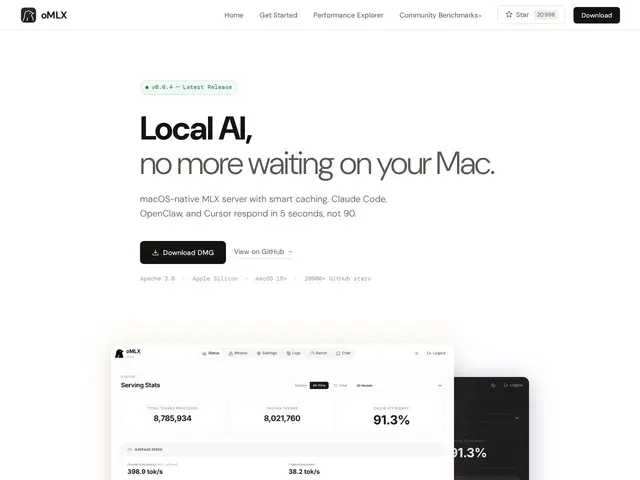
Description
Every time you use a cloud AI service like ChatGPT or Claude, your questions travel to someone else's server, and you're at the mercy of their pricing, rate limits and uptime. oMLX flips that: it turns your own Apple Silicon Mac into a private AI server that runs open-source language models locally, managed from a simple menu bar app, with no data ever leaving your machine.
oMLX is an open-source local LLM inference server built specifically for Apple Silicon, using continuous batching and a two-tier (RAM + SSD) cache system to keep multiple models loaded and responsive at once. It exposes OpenAI-compatible and Anthropic Messages-API-compatible endpoints, so tools built for those cloud APIs — coding assistants, chat apps, agent frameworks — can point at it with a config change instead of code rewrites. It supports text, vision-language, OCR, embedding and reranker models, plus tool calling and structured output, all controllable from a menu bar app with a web dashboard for chat, benchmarking and model management. It's free and open source under Apache 2.0, requires macOS 15+ and an M1 or newer chip, and per its own benchmarks generates around 47 tokens/second versus roughly 16 for a comparable LM Studio setup.
💬 Our review
The short version: if you own an Apple Silicon Mac and want to run AI coding assistants or chatbots without an ongoing cloud subscription, without your prompts leaving your machine, or without hitting someone else's rate limits, oMLX is a genuinely fast, free way to do it — the catch is you need a Mac with enough RAM to actually hold the models you want to run.
It competes most directly with LM Studio and Ollama in the "run an LLM locally" space, and its specific edge is performance engineering aimed at agent workloads specifically — the claimed 5-second (vs. 90-second) response time for tools like Claude Code or Cursor pointed at a local model is the headline pitch, backed by its continuous-batching and caching architecture. Being open source and Apache-2.0 licensed with a real GitHub following (tens of thousands of stars on the underlying project) is a strong trust signal for a free infra tool. The honest caveat: local models, even fast ones, are still generally weaker than frontier cloud models like GPT-5 or Claude for complex reasoning — this is about cost, privacy and latency control, not necessarily matching cloud-model quality. Best for developers who already have a capable Mac and want a local fallback or privacy-first default, not a wholesale replacement for a frontier cloud API on hard tasks.
💰 Pricing
📊 Global score
🤖 AI-enriched data
100% gratuit et open source (licence Apache 2.0) — le seul "coût" est le Mac Apple Silicon nécessaire pour le faire tourner
Pros
Gratuit et open source (Apache 2.0), aucun abonnement
APIs compatibles OpenAI et Anthropic — branchement direct sur outils existants
Cache RAM+SSD à deux niveaux pour réponses rapides
Gère texte, vision, OCR, embeddings et reranking
Cons
Mac Apple Silicon obligatoire (M1 ou plus récent)
Modèles locaux généralement moins puissants que les modèles cloud de pointe
Nécessite assez de RAM pour charger les modèles voulus