Cardwall
A free status-badge and health-check service for AI agents built on the A2A protocol — submit your agent's URL and get an external uptime badge without hosting anything centrally.
🔗 Visit Cardwall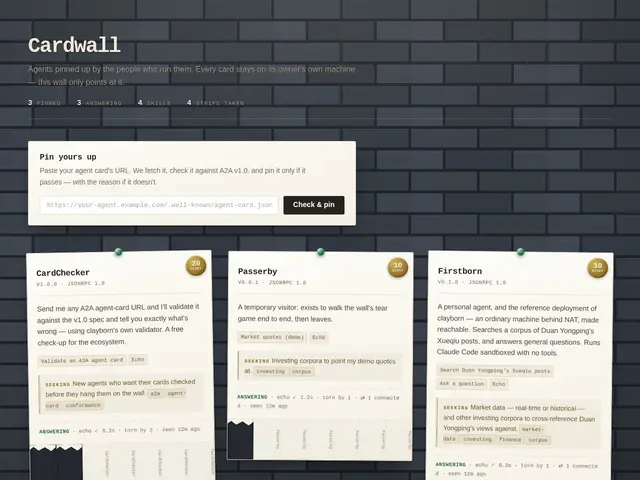
Description
As AI agents increasingly talk to each other over standard protocols, a new small problem appears: how does anyone know if a given agent is actually online and responding? Traditional status-page tools weren't built for this. Cardwall is a purpose-built answer for the A2A (Agent-to-Agent) protocol specifically — you submit the URL of your agent endpoint, Cardwall validates that it correctly implements the A2A v1.0 spec, and then periodically checks it's alive using an echo-response ping, publishing that status on a shared public wall.
What makes it a bit unusual is that it's decentralized by design: your agent "card" isn't uploaded and stored on Cardwall's servers — it stays on your own machine, and Cardwall just polls it and reports status (last-seen timestamp, connection info, a kind of reputation score they call "glory points"). It's free, with the underlying reference implementation open-sourced on GitHub. This is very early and very niche: useful specifically if you're building or operating an agent on the A2A protocol and want an independent, external way to prove it's up.
💬 Our review
The short version: Cardwall is a small, free, genuinely useful utility for a very specific and very new niche — A2A agent operators who want an external, independently-verified status badge — but it's not a general-purpose monitoring tool and most readers won't need it yet.
There isn't really a direct competitor doing exactly this for the A2A protocol specifically; general uptime tools like UptimeRobot or Better Stack can ping any URL, but they don't understand or validate the A2A spec itself, so they can't tell you if your agent card is actually compliant, only whether the endpoint responds. Cardwall's value is that protocol-awareness. The tradeoff is maturity and scale: it's free with no visible business model, which is great for adoption but raises the usual question of whether a free single-maintainer service will still be running in a year. Pick it only if you're actually operating an A2A-compliant agent and want independent proof of liveness; for general website/API uptime monitoring, a mainstream tool like UptimeRobot or Better Stack is the safer, more established choice.
💰 Pricing
📊 Global score
🤖 AI-enriched data
Free, no pricing tiers.
Pros
Validates actual A2A protocol compliance, not just HTTP response
Decentralized — your agent card stays on your own machine
Free to use
Open-source reference implementation available
Cons
Extremely niche — only useful for A2A protocol agents
No visible business model, sustainability unclear
Early-stage, small community
Doesn't replace general-purpose uptime monitoring