ParaQuery
A fully-managed, GPU-accelerated engine that runs your existing Spark and SQL workloads faster and cheaper on data already sitting in BigQuery, Snowflake, or Redshift.
🔗 Visit ParaQuery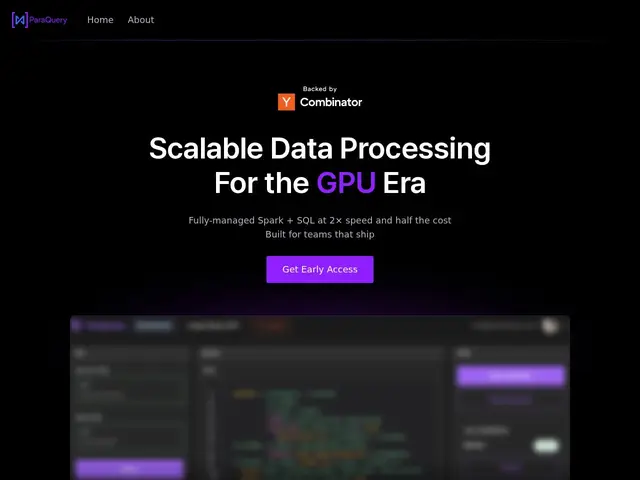
Description
Running large-scale data queries and ETL jobs on CPUs is the default in most data warehouses, but it's also slow and expensive at scale — the same reason gaming and AI moved to GPUs years ago. ParaQuery brings that same GPU acceleration to everyday Spark and SQL data processing, without asking you to move your data anywhere or rewrite your pipelines: it plugs into data you already have in BigQuery, Snowflake, or Redshift and runs the same queries faster.
Technically, ParaQuery is a fully-managed, Spark-compatible platform that claims roughly double the performance at about half the cost compared to standard CPU-based processing on those warehouses, works across GCP, AWS, and Azure, requires no data ingestion or migration, and avoids vendor lock-in since your data stays where it already lives. It's aimed at data teams running meaningful ETL or query volume on major cloud data warehouses who are looking to cut both compute time and cloud spend. Pricing is enterprise/custom, with the company offering risk-free pilots and a custom ROI analysis before you commit — no public self-serve pricing is available. It's Y Combinator-backed and also supported by Google for Startups, AWS, Microsoft, and NVIDIA's startup programs, which lends some technical credibility given the GPU-acceleration angle.
💬 Our review
The short version: if your BigQuery, Snowflake, or Redshift bill is dominated by heavy Spark/SQL compute, ParaQuery's pitch — same queries, no migration, roughly half the cost — is worth piloting given they'll reportedly run the ROI analysis for you before you commit.
Against just optimizing your existing warehouse configuration or query patterns, ParaQuery's GPU layer is a more fundamental performance lever that doesn't require the same manual tuning effort. Against switching data warehouses entirely to a GPU-native platform, ParaQuery's no-migration promise is the key advantage — you keep your existing data and tooling. The obvious caveat is that 'up to 2x faster, half the cost' is the vendor's own framing, and workload-dependent; the free pilot they offer is the right way to validate it on your actual queries rather than taking the number at face value. With fully custom, sales-gated pricing, this is squarely an enterprise-data-team tool, not something to self-serve for a small workload. Pick it if your warehouse compute bill is a real budget line; skip it if your data volume doesn't come close to needing GPU acceleration.
💰 Pricing
📊 Global score
🤖 AI-enriched data
Enterprise/custom pricing with free pilot and ROI analysis; no public self-serve rates.
Pros
No data migration required, works on data already in your warehouse
Claimed ~2x performance at ~half the cost vs standard CPU processing
Cloud-agnostic (GCP, AWS, Azure), no vendor lock-in
Free pilot and custom ROI analysis offered before committing
Backed by Google, AWS, Microsoft, and NVIDIA startup programs
Cons
Performance/cost claims are vendor-reported and workload-dependent
Fully custom pricing, no public self-serve rates
Only worth it at meaningful data-warehouse compute volume
Newer company, less proven at large scale than Databricks