Ryvn
A DevOps platform that lets software vendors deploy and manage their app inside enterprise customers' own cloud accounts, from one central control plane.
🔗 Visit Ryvn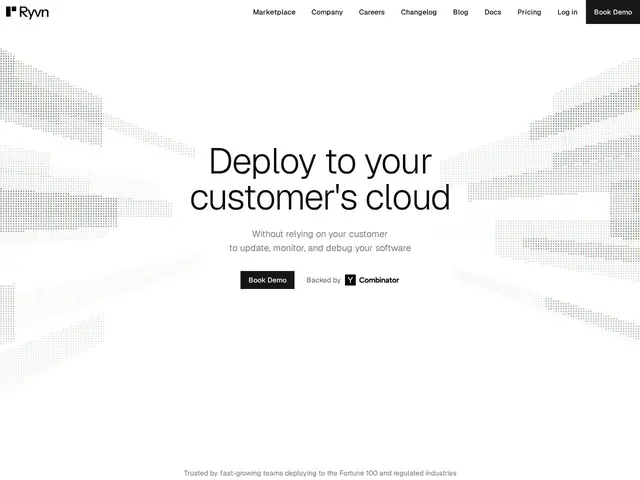
Description
Selling software to large enterprises — especially in healthcare, finance, or government — often runs into a hard requirement: the customer wants your application running inside their own cloud account, not yours, for compliance or data-residency reasons. That's usually a nightmare to support, because now you need to update, monitor, and debug software running somewhere you don't control, often depending on the customer's own IT team to help. Ryvn is built to remove that dependency, letting a vendor deploy into a customer's AWS, GCP, or Azure account while still centrally managing updates and troubleshooting as if it were their own infrastructure.
Technically, Ryvn orchestrates deployments across AWS, GCP, Azure, Kubernetes, Docker, and Terraform-managed infrastructure, plus on-prem, from a single control plane, with GitOps integration, staged rollouts, fleet management across many customer accounts at once, and AI-agent-assisted remote debugging so issues can often be resolved without looping in the customer's IT staff. It's aimed squarely at software vendors selling bring-your-own-cloud (BYOC) deployments to regulated-industry customers. Pricing is custom and tiered: a Starter tier for teams closing their first BYOC deals, and a Custom tier adding SSO/SAML, RBAC, a dedicated engineer, and an SLA — both require a sales conversation. It's Y Combinator-backed, founded by infrastructure veterans from Palantir, Vercel, and Capital One.
💬 Our review
The short version: Ryvn is solving a specific, painful, and expensive problem — supporting bring-your-own-cloud deployments — that most DevOps tools simply don't address, which makes it worth a serious look if that's genuinely your situation.
Against building BYOC deployment tooling in-house with raw Terraform and CI/CD scripts, Ryvn's advantage is the fleet-management layer across many customer environments at once, plus AI-assisted remote debugging that reduces how often you need the customer's own engineers involved. Against not offering BYOC at all and just hosting everything yourself, Ryvn only matters if your sales team is actually losing enterprise deals over data-residency requirements — if it isn't, this solves a problem you don't have yet. Pricing being fully custom and gated behind sales conversations makes it hard to gauge cost upfront, and as with any young, YC-backed infrastructure company, expect the product surface to still be evolving. Pick Ryvn if BYOC is already a named blocker in enterprise sales cycles; skip it otherwise.
💰 Pricing
📊 Global score
🤖 AI-enriched data
Custom pricing: Starter tier for first BYOC deals; Custom tier adds SSO/SAML, RBAC, dedicated engineer, SLA.
Pros
Purpose-built for bring-your-own-cloud (BYOC) enterprise deployments
Single control plane across AWS, GCP, Azure, Kubernetes, and on-prem
AI-assisted remote debugging reduces customer IT dependency
Fleet management across many customer environments at once
Founded by infrastructure veterans from Palantir, Vercel, Capital One
Cons
Fully custom pricing, requires a sales conversation to evaluate cost
Only valuable if BYOC is a real, named requirement from customers
Young company, product surface likely still evolving
No public case studies with concrete metrics available