Savant
A tool that pulls scattered company knowledge — documented and unwritten — out of your existing apps into one searchable layer, for both humans and AI agents.
🔗 Visit Savant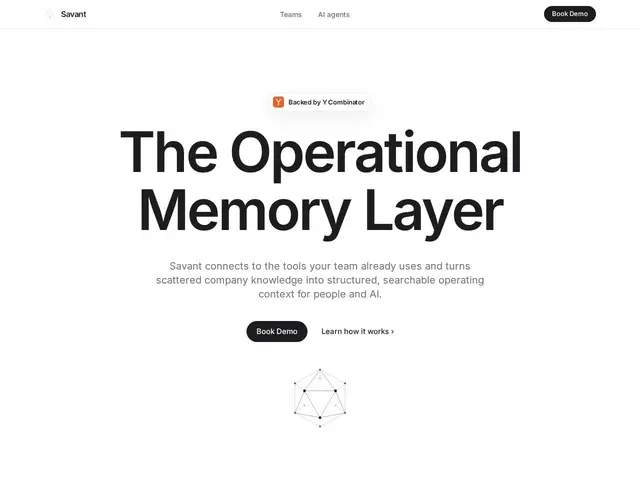
Description
Every company has knowledge that isn't written down anywhere — the unofficial rule about how a certain client likes invoices formatted, the workaround someone figured out for a recurring bug, the reason a process changed six months ago. Savant is built to capture that kind of knowledge, alongside the stuff that is documented across your tools, and turn all of it into one place you (or an AI agent) can actually search and query.
Technically, Savant integrates with tools like Google Workspace, Office 365, Salesforce, Slack, Zendesk, Intercom, and custom databases, structuring what it finds into queryable context layers without requiring data migration to a new platform. It's designed to capture unwritten operational procedures and edge cases specifically, continuously update as your organization changes, and feed AI agents the policies, workflows, and constraints they need to make good decisions rather than generic ones. It's a proprietary, Y Combinator-backed product (Bledger, Inc.) that positions itself against traditional enterprise search, document chatbots, wikis, and knowledge bases. Pricing isn't published; you book a demo to get a quote.
💬 Our review
The short version: Savant's real bet is that the knowledge worth capturing is the stuff nobody bothered to write down — and if that's genuinely your team's problem, it's a more ambitious and more useful target than a standard wiki or search tool.
Against a traditional wiki or knowledge base, Savant's pitch is that it doesn't rely on people remembering to document things — it pulls context from where work already happens. Against enterprise search tools like Glean, which mainly index and surface existing documented content, Savant's stated differentiator is specifically capturing unwritten operational knowledge, which is a harder and less provable claim to verify from the outside. The undisclosed pricing (demo required) is a real friction point for a small team wanting to evaluate quickly, and 'captures unwritten knowledge' is the kind of claim that's genuinely hard to assess without trying it on your own messy, real-world data. Pick Savant if scattered undocumented tribal knowledge is a real, named pain point for your team; a standard wiki or search tool is simpler if your knowledge problem is mostly 'things are documented but hard to find.'
💰 Pricing
📊 Global score
🤖 AI-enriched data
Pricing not disclosed publicly; requires booking a demo for a quote.
Pros
Targets unwritten/tribal knowledge, not just documented content
Integrates with existing tools (Google Workspace, Salesforce, Slack, Zendesk, Intercom) without migration
Continuously updates as the organization changes
Built specifically to feed AI agents usable business context
Backed by Y Combinator
Cons
Pricing not published — requires a demo call to even get a quote
'Captures unwritten knowledge' is a hard claim to verify without a hands-on trial
Proprietary, no self-hosting option
Value depends heavily on how much of your knowledge really is undocumented vs. just poorly organized