Pentagon
A workspace where multiple AI agents coordinate as a team — with shared channels, task tracking, and human oversight — instead of operating as isolated tools.
🔗 Visit Pentagon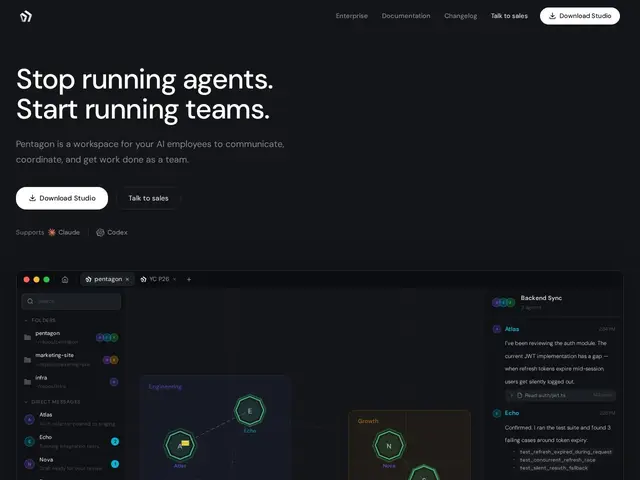
Description
Most AI agent tools work like separate contractors: you give each one a task, it does that one thing, and it has no idea what the others are doing. Pentagon is built around a different idea — treating a group of AI agents like a team that talks to each other, the way human coworkers do in a shared Slack channel, so they can coordinate on bigger, multi-step work without you manually relaying information between them.
Technically, Pentagon provides a Spatial Canvas visual workspace showing agent status and activity, Team and Channel organization for structured agent groupings, agent persistence for institutional memory across sessions, human-in-the-loop oversight with live status reports, granular access control at the folder/tool/action level, real-time task tracking, and self-organizing group-chat coordination between agents. It currently supports Claude and Codex, with hardware-level sandboxing listed as coming soon. Pentagon is Y Combinator-backed (batch P26, from Arlington Labs, Inc.), proprietary rather than open-source, with a free Studio download and custom enterprise pricing for larger deployments.
💬 Our review
The short version: Pentagon is solving a real coordination problem — agents that can't talk to each other duplicate work and lose context — but it's early-stage, single-company-backed, and worth piloting rather than betting core operations on just yet.
Against building your own multi-agent orchestration with a framework like CrewAI or AutoGen, Pentagon's advantage is that coordination, access control, and human oversight are built into a visual product rather than something you assemble and maintain yourself in code. Against simply using Slack with humans supervising individual agents, Pentagon's pitch is native agent-to-agent coordination rather than humans manually relaying messages between tools. The caveats: it's proprietary (no self-hosting or code audit option), currently limited to Claude and Codex, and the security-sensitive feature — hardware-level sandboxing — is still 'coming soon' rather than shipped, which matters if you're running agents with real system access. Pick Pentagon if agent-to-agent coordination is your actual bottleneck and you're comfortable being an early adopter; wait if sandboxing and broader model support are dealbreakers.
💰 Pricing
📊 Global score
🤖 AI-enriched data
Free Studio download. Enterprise deployments with custom pricing.
Pros
Native agent-to-agent coordination, not just isolated single-agent tools
Visual Spatial Canvas shows agent status and activity in real time
Human-in-the-loop oversight and granular access control built in
Agent persistence for institutional memory across sessions
Free Studio download to try before committing
Cons
Proprietary — no self-hosting or source code audit
Currently limited to Claude and Codex agents
Hardware-level sandboxing still 'coming soon', a gap for security-sensitive deployments
Early-stage, single-company-backed product (YC P26)