InferCrane
An open-source inference operations platform that puts one stable, OpenAI-compatible endpoint in front of your application, whether it is served by a hosted model API or your own self-hosted models.
🔗 Visit InferCrane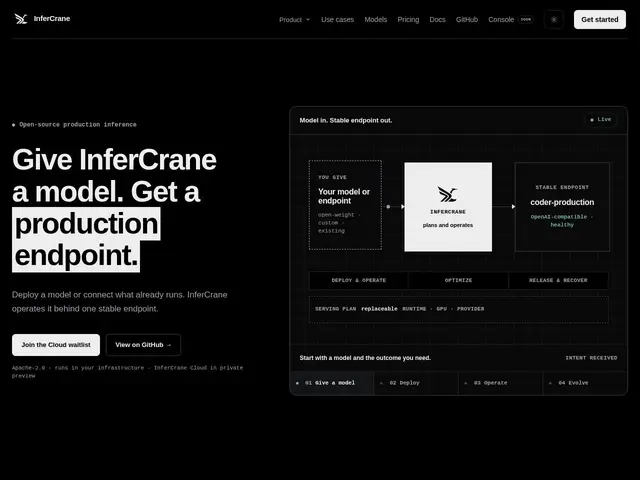
Description
If your team builds AI features, you have probably faced this trade-off: pay a hosted model API by the token, which is easy but can get expensive and locks you into that provider's pricing and uptime, or run your own model on your own GPUs, which is cheaper at scale but means someone has to deploy, scale, and babysit that infrastructure. InferCrane tries to remove the trade-off by sitting between your application and whichever option you choose -- your app always talks to the same stable address, and InferCrane handles what is actually running behind it, so you can start with a hosted API and move workloads to self-hosted infrastructure later (or the reverse) without rewriting application code.
Under the hood, InferCrane is an open-source (Apache-2.0) control plane, CLI, and gateway that exposes an OpenAI-compatible endpoint and can either deploy and autoscale open-weight models itself or simply observe and route to inference you already run on engines like vLLM, SGLang, or LiteLLM, without forcing a migration. Its 'Release Guard' feature lets teams benchmark a candidate deployment against the currently active one -- comparing latency, throughput, and error rates -- before shifting production traffic over, and its monitoring layer provides request tracing and diagnostics. A stated design principle is measured evidence over marketing: the product explicitly avoids 'invented savings or prices,' instead showing whether owning inference is actually cheaper than a given API for your specific workload based on real benchmarks. The self-hosted core is free and open source today; a managed 'InferCrane Cloud' offering exists but is currently private-preview/waitlist-only with no public pricing.
💬 Our review
The short version: InferCrane is a solid, genuinely open-source answer to 'how do I stop re-architecting my app every time I switch between a model API and self-hosted inference,' aimed squarely at teams who already have real inference workloads to manage.
It competes most directly with LiteLLM's proxy/gateway (which InferCrane can actually sit alongside and observe rather than replace), with managed inference platforms like Baseten or Modal, and with rolling your own setup on raw vLLM or SGLang. Compared to LiteLLM, InferCrane goes further by adding deployment/autoscaling and release-comparison tooling on top of routing, rather than just being a proxy layer; compared to Baseten or Modal, it stays open-source and self-hostable rather than being a fully managed black box, which is more work to run yourself but avoids vendor lock-in and per-request markup. The honesty around 'no invented savings or prices' -- showing measured evidence instead of marketing-style cost claims -- is a real strength in a category full of hand-wavy TCO comparisons. The catch: the hosted 'InferCrane Cloud' option, which would make this easiest to adopt for teams that do not want to run a control plane themselves, is still private-preview/waitlist-only with no published pricing, so today this is realistically a self-hosted, DIY-friendly tool rather than a turnkey SaaS. Worth adopting now if you are comfortable self-hosting; worth watching if you are waiting for the managed version.
💰 Pricing
📊 Global score
🤖 AI-enriched data
Core control plane, CLI, and gateway are free and open source (Apache-2.0), self-hosted. Managed 'InferCrane Cloud' is in private preview/waitlist with no published pricing yet.
Pros
Fully open source (Apache-2.0) core -- free to self-host, no vendor lock-in
One stable OpenAI-compatible endpoint regardless of what is serving traffic behind it
Can observe/manage existing inference (vLLM, SGLang, LiteLLM) without forcing migration
Explicit focus on measured cost/performance evidence rather than 'invented savings or prices'
Cons
Managed 'InferCrane Cloud' is private-preview/waitlist-only, no public pricing yet
Self-hosting the control plane still requires real infrastructure/ops effort
Very new product (Show HN Aug 28, 2026) with limited production track record
No named alternatives directly addressed on-site -- harder to judge maturity vs. established players