Drizz
An AI-powered mobile test automation platform where QA teams write tests in plain English and run them on real Android and iOS devices, with self-healing tests that adapt when the UI changes.
🔗 Visit Drizz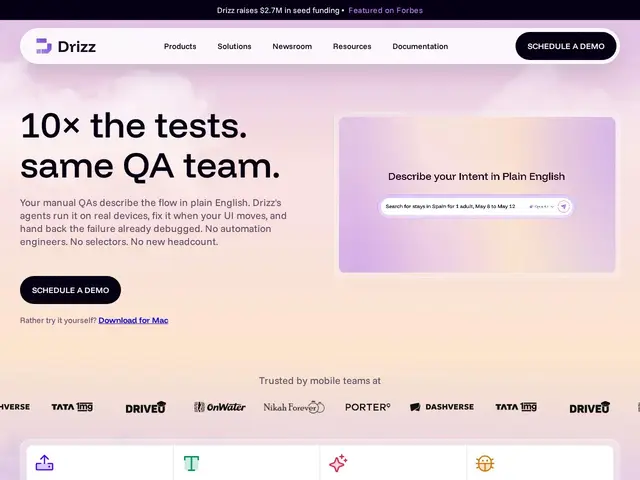
Description
Testing a mobile app the traditional way usually means writing brittle scripts that break every time a button moves or a screen gets redesigned — and then someone on the team has to spend hours fixing them instead of building the product. Drizz tries to remove that tax: you describe what you want tested in plain English, like you'd explain it to a new teammate, and the platform figures out how to run that test on a real phone or tablet, adjusting automatically when the app's interface changes.
Drizz executes tests on real Android and iOS devices using vision-AI-powered execution rather than brittle CSS/XPath-style selectors, which is what makes the 'self-healing' claim work in practice — when a button moves or a layout shifts, the AI re-locates the element instead of failing the whole test run. It plugs into existing CI/CD pipelines, supports writing a test once and running it on both platforms, includes accessibility testing, and gives centralized app management plus precision debugging with screenshots and logs when something does fail. The company positions Drizz against script-heavy tools like Appium, and cloud device farms like BrowserStack and LambdaTest, arguing that natural-language authoring cuts the maintenance burden those tools still require.
💬 Our review
The short version: if your QA team is drowning in flaky, hand-written mobile test scripts, Drizz's plain-English authoring and self-healing execution genuinely target the right pain point — the question is whether the AI holds up on your specific app's edge cases, which you can only really know by trying it.
Compared to Appium, the open-source standard, Drizz trades scripting control and zero licensing cost for a much lower maintenance burden — Appium tests are precise but famously brittle and demand ongoing selector upkeep, which is exactly what Drizz's vision-AI approach is built to avoid. Compared to device-farm services like BrowserStack or LambdaTest, which mostly solve 'where do I run my tests,' Drizz also solves 'how do I write and maintain them,' which is a different and arguably harder problem — but it means you're trusting an AI layer to interpret your intent correctly, which won't be 100% reliable on complex or unusual UI flows. Pricing is usage-based (pay-per-run above a 50-run free trial) plus a separate enterprise tier for on-prem/VPC and SSO needs, which is reasonable for teams that want to pilot before committing, though costs can add up for high-volume test suites. Worth a trial if manual test maintenance is your actual bottleneck; less compelling if your existing Appium suite is already stable and your team just needs more device coverage.
💰 Pricing
📊 Global score
🤖 AI-enriched data
Essai gratuit 50 executions de tests ; ensuite paiement a l'usage. Plans equipe avec collaboration. Palier entreprise avec deploiement on-prem/VPC, executions illimitees, SSO/SAML, SLA sur mesure.
Pros
Redaction de tests en langage naturel, sans code
Tests auto-reparants qui s'adaptent aux changements d'UI
Execution sur vrais appareils Android et iOS
Cons
Tarification a l'usage qui grimpe vite sur gros volumes
Interpretation IA pas fiable a 100% sur des flux UI complexes
Moins de controle fin qu'un outil scripte comme Appium