EBM Lens
An open-source agentic RAG system that searches 12 biomedical databases and produces a source-cited synthesis of the evidence.
🔗 Visit EBM Lens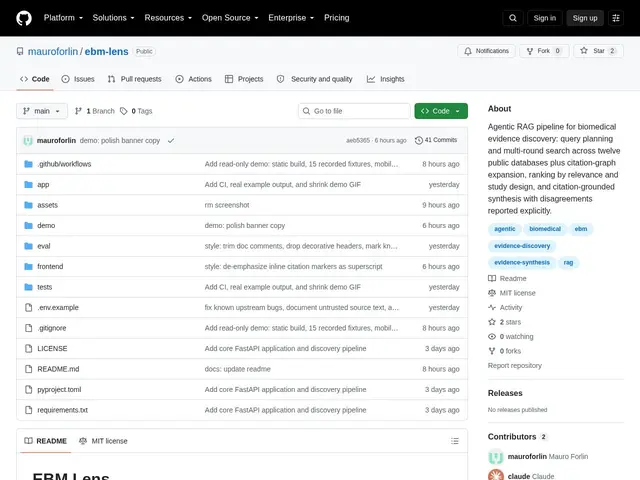
Description
Doing a proper literature review on a medical question usually means searching multiple databases by hand, reading dozens of papers, and manually weighing which studies are actually strong evidence versus which are weak or contradicted — a process that can take days even for an experienced researcher. EBM Lens automates the search-and-synthesis part: ask it a question in plain language, and it searches twelve public biomedical databases, follows citation networks to find related work, and returns a synthesis where every claim is tied to a specific source.
It ranks findings using a mix of semantic search, keyword matching, citation authority, and study design quality (so a randomized trial outranks a case report), explicitly flags when sources disagree with each other, and includes a citation-verification step specifically designed to prevent the system from inventing references that don't exist. It streams progress in real time, keeps no persistent storage (in-memory only), and is free and open source under the MIT license.
💬 Our review
The short version: a genuinely ambitious open-source tool for anyone doing evidence-based medical research — the citation-verification and study-design-aware ranking are the parts that matter most, since hallucinated or unweighted citations are exactly what makes AI-assisted literature review risky in a medical context.
There's no free, open-source direct equivalent doing structured biomedical evidence synthesis quite this way — most alternatives are either general-purpose AI search tools without medical evidence weighting, or paid institutional literature-review platforms. Being free and MIT-licensed is a real advantage for individual researchers and smaller institutions that can't afford enterprise EBM software. As with any AI-assisted evidence tool, the output should be treated as a strong starting point for a literature review, not a final clinical decision — verify the cited sources yourself before relying on the synthesis.
💰 Pricing
📊 Global score
🤖 AI-enriched data
Open source sous licence MIT.
Pros
Recherche 12 bases biomédicales plus réseaux de citations
Étape de vérification des citations contre les références inventées
Classement par qualité de méthodologie, pas seulement pertinence
Gratuit et open source (MIT)
Cons
Pas de persistance, les résultats ne sont pas sauvegardés
Domaine limité au biomédical
Les sources citées doivent encore être vérifiées avant usage clinique