itsnotes
A self-hosted note-taking app that feels like Google Keep's quick sticky notes, but adds folders, a timeline view, and lets you keep everything on your own server instead of Google's.
🔗 Visit itsnotes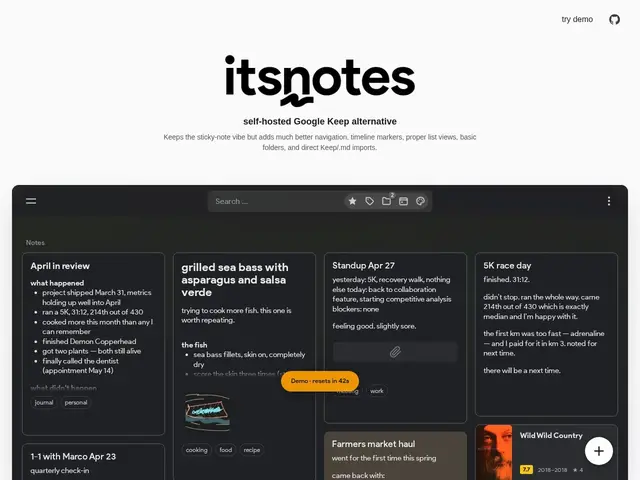
Description
Google Keep is popular because it's fast — open it, jot a note, done — but it offers almost no organization once you have hundreds of notes, and everything lives on Google's servers. itsnotes copies the part people actually like about Keep (quick, card-based notes with zero friction) and fixes the parts that frustrate long-time users: it adds folders, a timeline view with month markers so you can find old notes by when you wrote them, multiple ways to browse (grid, stacked, dense list), and it runs entirely on your own server if you choose to self-host it.
itsnotes is an open-source, MIT-licensed project (built by developer alexmicuplusfour, actively maintained) that supports importing your existing notes directly from Google Takeout or an Obsidian vault, plus bulk markdown/text upload and two-way markdown file sync with automatic conflict resolution. It also ships a REST API with token authentication and a built-in MCP server, so AI tools and Claude Code-style clients can read and write notes programmatically. There's no paid tier — it's free to self-host, with optional AI features (auto-tagging, reminder parsing) built in rather than sold separately.
💬 Our review
The short version: if you like Google Keep's speed but want your notes off Google's servers and better organization once you have a few hundred of them, itsnotes is a genuinely well-targeted free alternative.
Against Google Keep itself, itsnotes trades convenience (zero setup, always synced) for control (your data, your server, no ads or account mining) — a fair trade for anyone already comfortable self-hosting other tools. Against heavier self-hosted note apps like Obsidian or Logseq, itsnotes deliberately stays lighter: it doesn't try to be a full knowledge-management system with backlinks and graph views, it stays close to the quick-capture sticky-note model, which is either exactly what you want or too limited depending on your workflow. The Google Takeout and Obsidian import paths make switching low-friction, and the REST API plus MCP server is a nice touch for anyone wiring notes into AI workflows. The tradeoff of self-hosting anything is maintenance — you're responsible for backups, updates, and uptime, which Google Keep handles invisibly. Worth it for privacy-conscious users with basic self-hosting comfort; not worth the setup effort if you just want Keep to keep working as-is.
💰 Pricing
📊 Global score
🤖 AI-enriched data
Gratuit, auto-hébergé, aucun palier payant identifié
Pros
Garde la simplicité de prise de note rapide de Google Keep
Ajoute dossiers, timeline et plusieurs vues absentes de Keep
Import direct depuis Google Takeout ou Obsidian, migration facile
Cons
Nécessite de gérer soi-même l'hébergement, les sauvegardes et les mises à jour
Moins riche qu'Obsidian pour la gestion de connaissances complexe (pas de liens/graphe)
Projet porté par un développeur indépendant, pas d'entreprise derrière