ServiceBeard
Turns a shared support mailbox into an issue tracker, syncing emails to GitHub, GitLab or Linear so a customer reply automatically becomes a ticket.
🔗 Visit ServiceBeard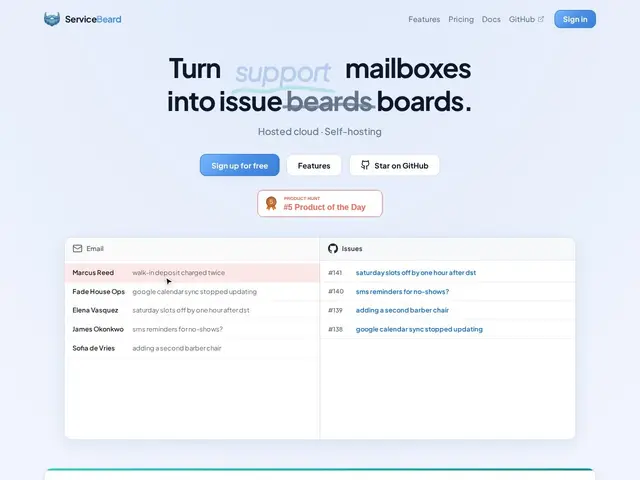
Description
Small teams handling customer support over email often face a bad choice: keep triaging a shared inbox by hand, or pay for a full helpdesk platform with per-seat pricing just to turn emails into trackable tickets. ServiceBeard sits in between — it connects to your existing mailbox and mirrors messages into your issue tracker automatically, so a customer email becomes a GitHub, GitLab or Linear ticket without anyone copy-pasting it.
ServiceBeard offers bidirectional mail-to-issue sync: incoming emails create or update issues, and replies to those issues can flow back out as emails, effectively turning a mailbox into an issue board. It connects over standard IMAP/SMTP, supports routing rules and team mailboxes, and is open source with both a managed cloud option and self-hosting available. It was built by a solo developer (Joram) and launched on Product Hunt in July 2026. Pricing isn't published on the landing page, and the marketing site itself is minimal — most of the substance is in the product's mail-to-issue mechanics rather than a polished sales page.
💬 Our review
The short version: if your team already runs its work in GitHub, GitLab or Linear but customer support still happens over email, ServiceBeard lets you skip buying a full helpdesk suite just to turn that email into tickets.
The appeal here is narrow and specific rather than broad: instead of a general-purpose helpdesk like Zendesk or Front, ServiceBeard does one thing — sync mailbox and issue tracker — and does it as an open-source, self-hostable tool, which matters if you don't want customer emails living inside a third-party SaaS platform. That also means it won't replace a helpdesk if you need SLAs, canned responses, or a full support agent workflow; it's closer to plumbing than a support desk product. Being a solo-developer, freshly launched project (July 2026) with an unpublished pricing page and a sparse marketing site is a real caveat — evaluate it as an early-stage tool, not a mature vendor with support guarantees. Worth trying for small dev teams and agencies that want tickets to live where the engineering work already happens, without adopting a separate support tool; not a fit if you need enterprise helpdesk features today.
💰 Pricing
📊 Global score
🤖 AI-enriched data
Aucune tarification publiée sur la landing page ; projet open source avec option self-hosting, suggérant un usage gratuit possible en auto-hébergement.
Pros
Synchronisation bidirectionnelle mailbox <-> issue tracker (GitHub, GitLab, Linear)
Open source avec option self-hosting — les emails clients ne transitent pas forcément par un SaaS tiers
Connexion via IMAP/SMTP standard, pas de migration d'outil requise
Règles de routage et boîtes mail d'équipe supportées
Cons
Produit très récent (lancé juillet 2026), développeur solo
Aucune tarification publiée
Site marketing minimal, peu de documentation publique
Ne remplace pas un helpdesk complet (pas de SLA, réponses type, etc.)