Upptime
A free status page and uptime monitor that runs entirely on GitHub's infrastructure — no server to rent, no monitoring account to pay for, just a GitHub repository checking your website every few minutes.
🔗 Visit Upptime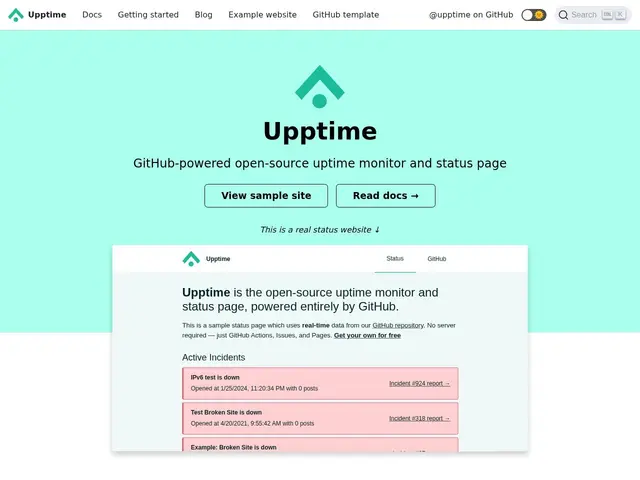
Description
Most uptime-monitoring tools want you to sign up for an account and pay a monthly fee to have their servers periodically check whether your website is alive. Upptime takes a different, clever approach: it repurposes GitHub Actions (the automation feature already built into GitHub) to do the checking for free, and stores the results as commits and issues in a regular GitHub repository — turning your existing GitHub account into the monitoring infrastructure, with no separate service to sign up for.
Upptime is an open-source uptime monitor and public status page that uses GitHub Actions to ping your endpoints every 5 minutes, records response-time history as version-controlled commits, opens a GitHub Issue automatically when something goes down (which doubles as an incident log), and generates a polished Svelte-based public status page from GitHub Pages. It supports Slack, Telegram, and custom webhook notifications, and is used by 3,000+ organizations including Canonical. With 17,000+ GitHub stars and an MIT license, it's a well-established choice specifically for teams that want uptime monitoring without adding another paid SaaS subscription to the stack.
💬 Our review
The short version: Upptime is close to the best option available if your website already lives on GitHub and you want uptime monitoring and a public status page without paying for a dedicated monitoring service — the entire thing runs on infrastructure you already have for free.
The git-native design is what makes it stand out: your uptime history is a version-controlled, auditable commit log rather than data locked in someone else's dashboard, and incidents become GitHub Issues, which slots naturally into a workflow a dev team already uses. The Svelte status page it generates is genuinely presentable, not a bare-bones placeholder, so it's usable as a real public-facing page.
The honest limits: because it runs on GitHub Actions' schedule, checks happen roughly every 5 minutes rather than continuously — for services where a 30-second outage matters commercially, a paid real-time monitor will catch problems faster. It's also fundamentally a GitHub-centric tool: teams not already comfortable in a GitHub-based workflow, or wanting monitoring integrated into a broader observability platform (metrics, tracing, logs together), will find a tool like Better Stack or Datadog a more natural fit despite the cost.
💰 Pricing
📊 Global score
🤖 AI-enriched data
Entièrement gratuit et open source (licence MIT) — fonctionne sur les GitHub Actions/Pages déjà inclus dans un compte GitHub.
Pros
Entièrement gratuit — tourne sur les GitHub Actions/Pages déjà disponibles
Historique de disponibilité versionné en Git, auditable, pas enfermé dans un dashboard tiers
Page de statut publique générée automatiquement, esthétiquement soignée
Adopté par 3000+ organisations, dont Canonical
Cons
Vérifications toutes les ~5 minutes seulement, pas de monitoring temps réel
Pensé pour un workflow centré GitHub — moins naturel hors de cet écosystème
Pas de plateforme d'observabilité unifiée (métriques, traces, logs) comme les outils payants