LangGraph
A code library from the LangChain team for building AI agents that can pause, remember where they were, and pick back up later — even after a server restart — instead of losing all progress if something goes wrong mid-task.
🔗 Visit LangGraph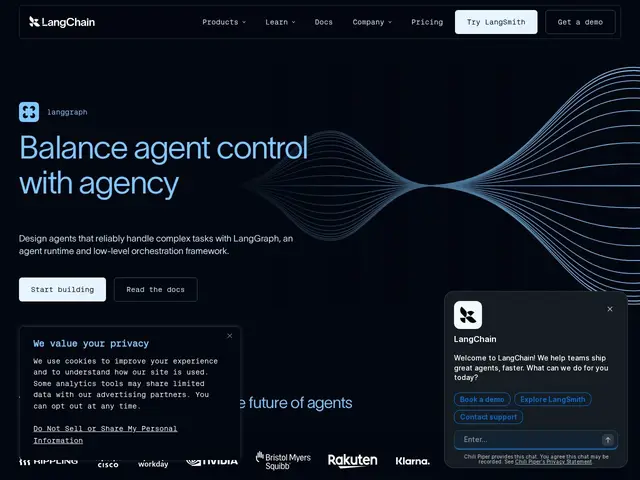
Description
A simple AI agent script that crashes halfway through a long task usually just loses all its progress and has to start over. LangGraph is built to prevent exactly that: it treats an agent's process as a graph of steps with saved state at each point, so if something fails, it can resume from where it left off rather than restarting from scratch — similar to how a video game autosaves your progress instead of forcing you to replay the whole level after a crash.
LangGraph is LangChain's low-level orchestration library for building stateful, production AI agents as directed graphs. Its core selling points are durable execution (automatic resumption after failures), built-in human-in-the-loop controls, short-term and long-term memory primitives, native token-by-token streaming, and support for single-agent, multi-agent, and hierarchical agent architectures. It's deliberately lower-level than a no-code agent builder, giving developers fine-grained control over exactly how an agent's state and flow are managed. With 40,000+ GitHub stars, integration with LangSmith for debugging/observability, and production use at companies like Klarna, Replit, and Elastic, it's one of the most established choices for developers who've outgrown simpler agent frameworks.
💬 Our review
The short version: LangGraph is the right tool once you're a developer who has outgrown simple agent wrappers and needs precise, reliable control over how an AI agent's state, memory, and multi-step flow actually work — it's free, well-documented, and proven at real production scale.
Durable execution is the feature that matters most in practice: long-running agent tasks fail for mundane reasons (a timeout, a rate limit, a server restart), and being able to resume from a checkpoint instead of restarting is a meaningful reliability win that most lighter agent frameworks don't offer out of the box. The human-in-the-loop primitives and native streaming also solve two problems every production agent eventually hits — needing a person to approve a risky action, and needing to show partial output to a user in real time rather than a long silent wait.
The honest caveats: this is deliberately a low-level library, not a drag-and-drop builder — expect to write real code and think explicitly about graph structure, which is a steeper starting point than a no-code tool like Dify or a higher-level wrapper. For a simple one-shot AI feature with no multi-step state to manage, adopting LangGraph's graph model is unnecessary complexity; it earns its cost specifically on agents that need to run reliably over multiple steps or a long duration.
💰 Pricing
📊 Global score
🤖 AI-enriched data
Open source, gratuit (pip install). LangSmith, l'outil d'observabilité associé, a un palier payant séparé.
Pros
Exécution durable — reprise après échec au lieu de tout redémarrer
Primitives natives de human-in-the-loop et de mémoire court/long terme
Streaming token par token natif
Éprouvé en production (Klarna, Replit, Elastic), 40k+ étoiles GitHub
Cons
Bibliothèque bas niveau — nécessite d'écrire du code et de penser en graphes d'état
Courbe d'apprentissage plus raide qu'un outil no-code comme Dify
Complexité inutile pour une fonctionnalité IA simple, sans état multi-étapes