Dify
An open-source platform for building AI chatbots and automated workflows by connecting blocks on a canvas, instead of writing code from scratch.
🔗 Visit Dify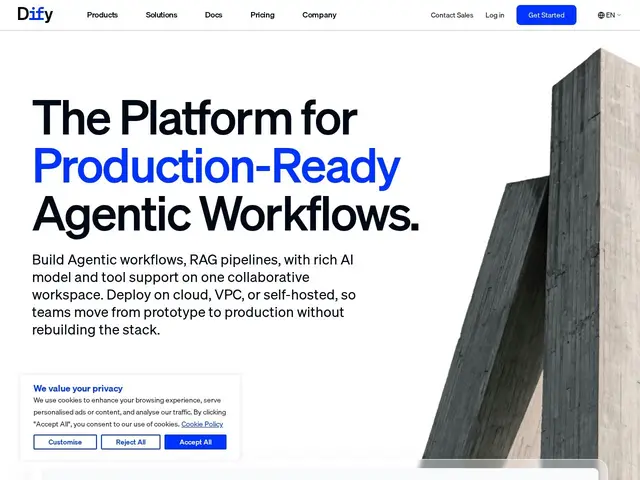
Description
Building something like a customer-support chatbot that can search your documents, call other software, and remember a conversation used to mean writing a lot of custom code to wire an AI model to all those moving parts. Dify turns that into something closer to arranging boxes on a whiteboard: you drag in a block for "read this database," another for "ask the AI model," another for "send a Slack message," and connect them with lines. The whole thing runs as a working app when you're done, without needing to be a professional developer to assemble it.
Under the hood, Dify is an open-source LLM application development platform combining a visual workflow builder, a RAG (retrieval-augmented generation) pipeline for grounding answers in your own documents, and an agent framework for tools that can take multi-step actions. It supports most major model providers (OpenAI, Anthropic, and dozens of others through a plugin marketplace) and can be run as a managed cloud service, self-hosted via Docker for full data control, or as an Enterprise deployment with SSO, SAML and RBAC. With 150k+ GitHub stars and production users including Adobe, PayPal and Mercedes-Benz, it has become one of the default choices for teams standardizing on one platform for AI app development rather than stitching together separate SDKs per project.
💬 Our review
The short version: Dify is a strong pick if you want to build and ship AI-powered apps (chatbots, agents, document Q&A) without hand-rolling the plumbing between your data, your AI model, and the tools it needs to call — and the fact it's open-source and self-hostable means you're never locked into their cloud if data residency or cost becomes a concern.
The visual workflow builder is genuinely productive once you're past the learning curve — chaining retrieval, model calls, and conditional logic into a working pipeline is much faster than writing the equivalent orchestration code by hand, and the built-in RAG and agent tooling save real setup time. The plugin marketplace for model providers means you're not locked into one vendor either, which matters given how quickly the model landscape shifts.
The honest caveats: a visual canvas that handles simple flows gracefully can get genuinely hard to reason about once a workflow has a dozen branches and nested conditions — some teams eventually outgrow the no-code layer and want raw code back. Self-hosting the full stack (vector DB, workers, orchestration) also isn't a five-minute job; budget real time for the Docker Compose setup if you're not using their cloud. For a solo developer building one simple chatbot, a lighter framework or a direct API call might be less overhead than adopting a full platform.
💰 Pricing
📊 Global score
🤖 AI-enriched data
Édition Community open source (Docker, auto-hébergée) gratuite. Dify Cloud (SaaS géré) et Dify Enterprise (SSO/SAML/RBAC) sur devis.
Pros
Constructeur visuel de workflows IA (RAG, agents, logique conditionnelle) très productif
Open source et auto-hébergeable — pas de dépendance forcée au cloud de l'éditeur
Marketplace de plugins pour brancher de nombreux fournisseurs de modèles IA
Adopté en production par de grandes entreprises (Adobe, PayPal, Mercedes-Benz)
Cons
Le canevas visuel devient difficile à suivre sur des workflows complexes à nombreuses branches
Auto-hébergement complet (vector DB, workers) demande un vrai temps de setup
Peut être surdimensionné pour un chatbot simple ou un projet solo