Haystack
An open-source toolkit for building AI systems that answer questions using your own documents — feeding an AI model your company's PDFs, wikis, or support tickets so it answers from real content instead of guessing.
🔗 Visit Haystack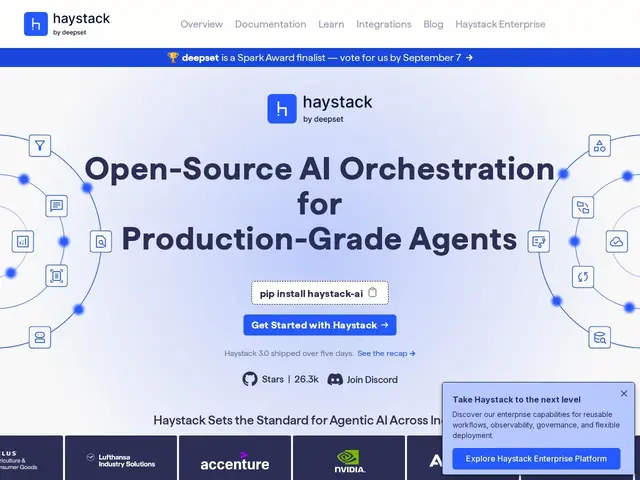
Description
A general AI chatbot will confidently answer questions about your company's internal policies even though it has never seen them — because it's guessing based on general knowledge, not your actual documents. Haystack solves that specific problem: it connects an AI model to a search system over your real documents, so instead of guessing, the model looks up the relevant passage first and then answers based on what it actually found — the same idea as an assistant who checks the manual before answering, rather than answering from memory.
Haystack, built by the German company deepset, is an open-source AI orchestration framework centered on RAG (retrieval-augmented generation), agent building, and modular, composable pipelines. It connects to most major LLM providers (OpenAI, Anthropic, Mistral, Hugging Face) and vector databases (Weaviate, Pinecone, Elasticsearch), supports Kubernetes deployment, tool calling, multimodal inputs, and async/streaming execution, with built-in logging and observability. With 26,000+ GitHub stars, an Apache 2.0 license, and production deployments at Apple, Meta, Netflix, and the European Commission, it's one of the more established frameworks specifically for retrieval-grounded AI applications rather than general-purpose agent building.
💬 Our review
The short version: Haystack is a strong, mature choice specifically for RAG — building an AI system that answers from your own documents — and its list of production users (Apple, Meta, Netflix, the European Commission) says a lot about how far it's been battle-tested beyond a demo project.
The modular, composable pipeline design is the real strength: components for retrieval, ranking, generation, and tool-calling can be swapped independently, so switching vector databases or LLM providers doesn't mean rebuilding the whole system — a genuine advantage over frameworks that couple you more tightly to one stack. Broad connector support (multiple vector DBs, multiple LLM providers) also means it rarely forces a specific vendor choice on you.
The honest caveats: it's a code-first framework for developers, with real setup investment before a working pipeline exists — there's no drag-and-drop mode. Its focus is deliberately retrieval/RAG-centric; for building a general-purpose autonomous agent that plans multi-step tasks with less emphasis on document grounding, a framework like LangGraph is a more natural fit. Enterprise support and the visual Enterprise Platform are separately paid, so budget for that if you need vendor support rather than community help alone.
💰 Pricing
📊 Global score
🤖 AI-enriched data
Open source gratuit (licence Apache 2.0, pip install). Support Enterprise et plateforme visuelle Enterprise payants, tarifs flexibles sur devis.
Pros
Pipelines modulaires et composables — changer de base vectorielle ou de fournisseur LLM sans tout reconstruire
Large support de connecteurs (Weaviate, Pinecone, Elasticsearch, OpenAI, Anthropic, Mistral, Hugging Face...)
Éprouvé en production chez Apple, Meta, Netflix, la Commission européenne
Open source (Apache 2.0), 26k+ étoiles GitHub, développement actif (version 3.0)
Cons
Framework code-first — investissement de configuration réel, pas de mode glisser-déposer
Focalisé RAG/recherche documentaire, moins adapté à un agent généraliste multi-tâches
Support Enterprise et plateforme visuelle payants séparément