VulnScout
Takes the list of every open-source component your software depends on (its SBOM) and tells you which ones have known security holes, then gives you a web dashboard to triage and report on them — rather than making you cross-reference vulnerability databa
🔗 Visit VulnScout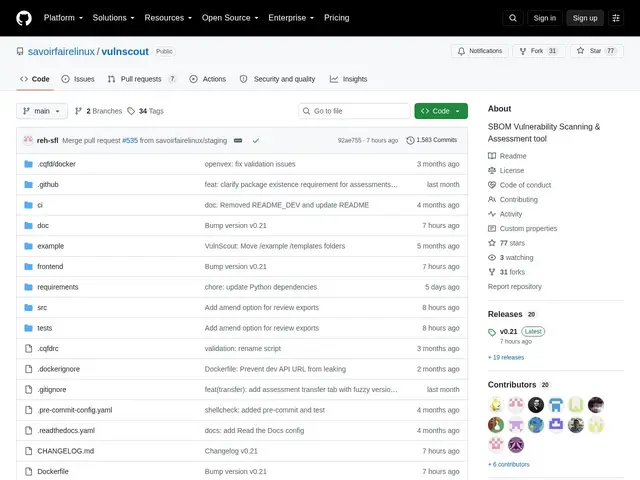
Description
Modern software is built from hundreds of open-source packages, and any one of them can quietly carry a known vulnerability. Regulations and big customers increasingly ask for an SBOM — a software bill of materials, basically an ingredients list — but having the list isn't the same as knowing which ingredients are actually dangerous right now. VulnScout reads that ingredients list and cross-checks it against vulnerability databases automatically, the way a nutrition app scans a barcode and tells you about allergens instead of making you read the label yourself.
VulnScout is an open-source (GPL-3.0) tool from Savoir-faire Linux that ingests SBOMs in multiple formats (SPDX 2/3, CycloneDX, Yocto CVE, OpenVEX) and enriches them with vulnerability data from the NVD, EPSS, and Grype. It provides a web-based triage interface, project/variant management for tracking multiple software builds, CI/CD integration with configurable pass/fail conditions, and report generation in AsciiDoc, HTML, PDF, or CSV — useful for both internal review and compliance documentation. It deploys via Docker and supports organization-specific CVSS scoring adjustments.
💬 Our review
The short version: VulnScout fills a specific gap that raw scanners like Grype or Trivy leave open — it's not another vulnerability scanner, it's a triage and reporting layer on top of the SBOMs those scanners already produce, and that's a genuinely useful, underserved niche.
The multi-format SBOM support (SPDX, CycloneDX, Yocto CVE) stands out — Yocto CVE support in particular signals this tool understands embedded/industrial software supply chains, not just typical web-app dependency trees, which tracks with Savoir-faire Linux's embedded Linux consulting background. The report generation in AsciiDoc/PDF/CSV is clearly built for the compliance paperwork side of vulnerability management, not just the technical triage.
The honest limits: at 77 stars, it's a small project relative to DefectDojo, the more established option for aggregating findings across many scanner types. VulnScout is narrower by design — it's specifically SBOM-centric rather than a general findings-aggregation platform — so the right comparison isn't 'which is better' but 'which fits your workflow': if you're already generating SBOMs and want a dedicated tool to triage and report on them, VulnScout's focus is an advantage; if you need to aggregate results from many different kinds of security tools (SAST, DAST, container scanning) into one place, DefectDojo's broader integration list is the safer bet.
💰 Pricing
📊 Global score
🤖 AI-enriched data
Open source (licence GPL-3.0), gratuit, auto-hébergé via Docker.
Pros
Gratuit et open source (GPL-3.0), auto-hébergé
Supporte plusieurs formats de SBOM (SPDX 2/3, CycloneDX, Yocto CVE, OpenVEX) — y compris l'embarqué
Interface web de triage dédiée, pas juste un scanner en ligne de commande
Génération de rapports (AsciiDoc, HTML, PDF, CSV) utile pour la conformité
Cons
Projet modeste (77 étoiles GitHub) comparé à DefectDojo pour l'agrégation de résultats de sécurité
Focalisé spécifiquement sur les SBOM — pas un agrégateur généraliste multi-scanners comme DefectDojo
Nécessite déjà un processus de génération de SBOM en amont pour être utile