Hoodik
A self-hosted Google Drive/Dropbox alternative where files are encrypted in your browser before they ever reach the server — so even the machine storing your files never sees what's actually in them.
🔗 Visit Hoodik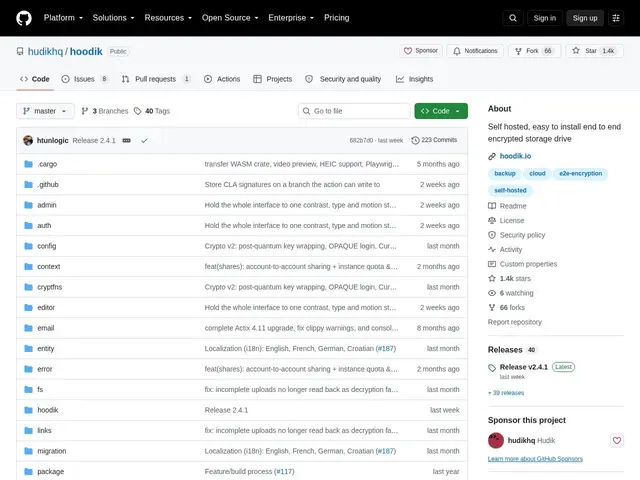
Description
Most cloud storage — including plenty that calls itself 'encrypted' — decrypts your files on the server at some point, which means the provider technically could look, and a server breach could expose everything. Hoodik is built around a stricter promise: encryption and decryption happen entirely in your browser, so the server that stores your files only ever sees encrypted blobs, never the actual content. It's closer to mailing someone a locked box than mailing a letter and trusting the courier not to read it.
Hoodik is a self-hosted cloud storage platform using AEGIS-128L encryption with a quantum-resistant hybrid key-wrapping scheme (X25519 + ML-KEM-768) — meaning it's designed to resist decryption even by future quantum computers, not just today's threats. It includes encrypted markdown notes with a WYSIWYG editor, shareable public links that decrypt only on the recipient's side, two-factor authentication, an admin dashboard, and chunked concurrent file transfers. It supports SQLite or PostgreSQL and S3-compatible storage, and deploys via multi-architecture Docker images. It's licensed CC BY-NC 4.0 (free for non-commercial self-hosting; commercial use requires a separate license), with an optional managed 'Hoodik Cloud' tier.
💬 Our review
The short version: Hoodik's core promise — genuine client-side, browser-based end-to-end encryption for self-hosted storage — is the real deal architecturally, and the quantum-resistant key wrapping is a forward-looking touch most self-hosted storage tools don't bother with yet.
At 1.4k stars with 223 commits, it's a reasonably established project for this category, and the feature set goes beyond bare file storage: encrypted notes, secure sharing links that only decrypt for the intended recipient, and proper 2FA are the kind of details that suggest a real product rather than a weekend project. Compared to Nextcloud (the default self-hosted 'Drive alternative'), Hoodik's differentiator is specifically that encryption happens client-side by design, not as a bolt-on encryption app running on top of a generally-decrypted file store.
The honest limits: the CC BY-NC 4.0 license means it's free for personal or non-commercial self-hosting but requires paying for a commercial license if a business wants to run it — read that carefully before deploying at a company. As with any encryption-heavy tool, the claims (AEGIS-128L, quantum-resistant key wrapping) are worth taking on faith unless you can read the cryptography code yourself or wait for independent audits; novel crypto choices are exactly where subtle implementation bugs hide. For an individual or non-commercial project wanting real client-side encrypted storage, Hoodik is one of the more architecturally serious options available; a business evaluating it should budget for the commercial license and, ideally, get the crypto reviewed independently first.
💰 Pricing
📊 Global score
🤖 AI-enriched data
Gratuit pour usage non-commercial en auto-hébergement (licence CC BY-NC 4.0) ; licence commerciale requise pour un usage professionnel ; offre cloud managée 'Hoodik Cloud' disponible.
Pros
Chiffrement/déchiffrement entièrement côté navigateur — le serveur ne voit jamais les données en clair
Chiffrement moderne (AEGIS-128L) avec encapsulation de clé résistante au quantique (X25519 + ML-KEM-768)
Notes chiffrées, liens de partage à déchiffrement côté destinataire, 2FA intégré
Projet établi (1.4k étoiles GitHub), déploiement Docker multi-architecture
Cons
Licence CC BY-NC 4.0 — gratuit en non-commercial seulement, licence payante requise pour un usage professionnel
Choix cryptographiques modernes/originaux (AEGIS-128L, post-quantique) pas encore largement audités indépendamment
Moins connu et moins éprouvé à grande échelle que Nextcloud pour l'auto-hébergement de fichiers